Marketing content

Resonandina at a glance

Problem

Problem
Many hospitals in emerging markets lack access to capital-intensive diagnostic and radiotherapy equipment despite clear medical demand.
[Learn more]

Solution

Solution
Resonandina enables hospitals to deploy high-end medical equipment through long-term pay-per-use lease agreements without large upfront investments.
[Learn more]

Market

Market
Radiotherapy and diagnostic imaging capacity in Latin America remains structurally underdeveloped, creating significant expansion and replacement demand.
[Learn more]

Competetion

Competition
Advanced medical equipment is typically sold through upfront purchase models that require substantial capital and financing capacity.
[Learn more]

Business model

Business model
Recurring revenues are generated through usage-based payments under long-term (8+ years) contracts with minimum volume commitments.
[Learn more]

Use of funds

Use of funds
This round finances a Linear Accelerator (Linac) in Cusco, Peru, expanding radiotherapy access in a region where cancer incidence is rising and treatment capacity remains limited.
[Learn more]

Important notice: All investments involve risks, including the possible loss of capital. Learn more here.

Floriaan van Bemmelen, CEO, Resonandina

“At Resonandina, we make advanced diagnostics and radiotherapy accessible where they are needed most. Our sustainable medical lease model enables hospitals to deploy high-end equipment without heavy upfront investment.

Since 2023, more than 5,000 investors have supported our growth across multiple successful campaigns. With this 8th round, we continue expanding our installed base by financing another Linear Accelerator in Cusco, Peru, strengthening regional cancer treatment capacity.

We appreciate the continued trust of our investor community and look forward to create impact together.” 

Floriaan van Bemmelen, CEO, Resonandina

Investment information

Days to invest:
20
Investing round ends:
23/03/2026
Type:
Bond
Subordinated:
no
Invested so far:
€2,085,250.00
Price per bond:
€250.00
Min offer:
1 Unit
Maximum issue size:
€2,500,000
in 10,000 Units
Interest:
semi-annual
Repayment:
semi-annual
after 6 Months
ISIN:
NL0015073VW6
Broker:
Oneplanetcrowd International B.V
License:
ECSPR

About Resonandina

Company profile

Resonandina: A pioneer in sustainable medical leasing

Resonandina is a profitable, sustainable medical lease scale-up founded in the Netherlands, dedicated to making diagnostics accessible to everyone. By offering pay-per-use leasing of high-quality, capital-intensive diagnostic and treatment equipment (MRI, PET/CT, Linac and more), Resonandina bridges the gap for hospitals that lack the resources or expertise to acquire such solutions. This model not only provides access to advanced equipment but also ensures economic and social returns in all activities.

Problem: Hospitals often lack resources or knowledge for capital-intensive medical equipment.

Solution: Resonandina developed an innovative all-inclusive pay-per-use medical lease model that makes diagnostics and treatment accessible for everyone.

Capital-intensive equipment becomes affordable for hospitals because a small amount has to be paid each month instead of a large lump sum. The key differentiator of Resonandina is the focus on a ‘simple’ and client-oriented “B2B” business model based on “Pay-per-Use” lease with an “all-inclusive” package. The service includes project design, investment, installation, training, full maintenance, and extended life cycle (with upgrades, reuse, and recycling). The hospital has all medical-related responsibilities such as patient logistics, quality management, liability and (insurance) invoicing.

Resonandina ensures that these hospitals can deploy advanced equipment so that diagnostics become affordable and available to all. This results in healthier people and fewer travel movements.

Resonandina started its services in 2015 in Bolivia with a step-by-step expansion across Latin America and the Caribbean. Submarkets are: “doctor owned” medium-size hospitals, larger professionally managed hospitals, and Public Healthcare Services.

Having a unique concept of “use it, don’t own it”, Resonandina has established a solid presence in the niche of high-end diagnostic and treatment equipment, supported by strong partnerships with GE Healthcare and Varian/Siemens Healthineers. Fundamental is the recurring revenue model with long-term (8+ years) contracts. With 16 units currently producing and 5 additional projects in installation and near-term pipeline, the company continues to expand its operational base.

Resonandina's 'Steady Growth' scenario targets 40+ projects and €27.5+ million ARR by 2030. Nevertheless the ambition goal is 75+ projects with €55 million ARR by 2030. Resonandina has successfully created a recognized market position, defined the service and operational execution, managed to create rising ARR and profitability, proven the concept, prepared footprints in the addressable markets and is ready for the next phase of growth. The current strategic focus remains primarily on the “home market” in the Americas, including expansion the USA. At a later stage expansion to other continents is optional.

Use of funds

While previous rounds mainly financed MRI installations in Latin America and the Caribbean, the 7th round was the first in cancer treatment (Linac) and diagnostics (PET/CT). This 8th campaign follows this line and will finance a Linear Accelerator (Linac) in a hospital in Peru, used in radiotherapy to treat cancer.

A Linac (Linear Accelerator) accelerates electrons in a straight line to generate high-energy X-rays, which are directed precisely at tumors during the therapy session. This destroys cancer cells while minimizing damage to healthy tissue. Because the radiation can be shaped to the exact contours of the tumor, treatment is both effective and highly targeted.

Developments since the last funding round with Invesdor

Find out more about what has happened since the last crowdfunding.

Company info 

Company name: Resonandina Holanda BV
Managing director: Floriaan van Bemmelen, CEO
Antonio Pimentel, COO
Luis del Valle, CFO
Business ID number: 64691772
Founding year: 2015
Address: Herengracht 449A
1017 BR Amsterdam
The Netherlands
Industry: Healthcare
Number of employees: 15
Locations: The Netherlands,
12 subsidiaries in Latin America, Caribbean and the USA
Starting points in EMEA & Asia
Website: resonandina.com
Social media:

Products and services

Resonandina developed an innovative sustainable medical lease model that makes diagnostics and radiotherapy accessible for everyone, while creating predictable, asset-backed recurring revenue streams.

High-quality equipment

Aligning with ongoing technological medical developments, hospitals need equipment that meets the highest standards - certified and guaranteed by leading manufacturers. Main areas of equipment include:

  • General Medicine, Traumatology, Orthopedics, Neurosurgery, Oncology, Cardiology (MRI, CT, Cath-Lab).
  • Radiotherapy (Linear Accelerator – Linac, Brachytherapy).
  • Nuclear Medicine (Cyclotron, PET/CT).

Resonandina focuses exclusively on high-end, capital-intensive medical equipment with strong secondary market value and long economic lifecycles. This ensures durable assets that serve both clinical impact and investor security.

Resonandina products

Full-service maintenance

Resonandina provides comprehensive, long-term maintenance without hidden fees. This includes:

  • Project design and site planning.
  • Delivery and installation.
  • Training, monitoring, and maintenance.
  • Upgrades and parts replacement to extend the equipment’s lifespan.

All services are executed by the OEM (e.g. GE Healthcare, Varian) or certified third parties, ensuring reliability, operational continuity, and preservation of asset value throughout the contract period.

By outsourcing technical responsibility to first-class manufacturers and certified service providers, operational risk is reduced and uptime is maximized - supporting stable cash flows.

Long-term commitment

Through long-term partnerships (typically 8-10 years), hospitals can focus on patient diagnostics and treatment, while Resonandina manages the equipment’s technical functionality and output optimization.

Minimum volume agreements and pay-per-use structures provide visibility on revenues while aligning incentives between Resonandina and the hospital. This results in reliable, efficient operations and recurring income backed by essential medical infrastructure.

Upgrade and reuse

At the end of a contract, equipment is upgraded to meet evolving technological and clinical expectations. Parts are reused or recycled where possible, enhancing sustainability and extending the equipment’s life cycle.

For example, Resonandina’s MRI program extends the life span of an MRI from approximately 90,000 scans to up to 135,000 scans. This approach not only reduces waste but also improves capital efficiency and long-term asset utilization.

How does it work?

This model allows hospitals to offer advanced diagnostic and radiotherapy services without the financial burden of purchasing equipment outright. By preserving operational liquidity and providing flexibility in financial planning, Resonandina ensures healthcare providers can focus on patient care.

The pay-per-use system, combined with volume discounts, incentivizes hospitals to maximize equipment usage, improving both efficiency and profitability. Resonandina offers a practical, transparent, and affordable financial solution for hospitals, while creating predictable recurring revenues.

Icon 1

Acquisition and installation

Resonandina purchases capital-intensive medical equipment, installs it in hospitals, and provides a comprehensive lifecycle service package. The equipment remains owned by Resonandina throughout the lease term.

Icon 2

Pay-per-use leasing

Hospitals operate the equipment and pay per scan or treatment. Costs decrease with higher usage volumes, creating incentives for efficiency and profitability.

Annual recurring revenue (ARR) typically represents approximately 25–35% of every €1 million invested in medical equipment, depending on modality and utilization levels.

The typical payback period of a device is approximately four years, while the economic lifetime of the equipment is significantly longer (10–15 years with proper maintenance).

Icon 3

Minimum volume guarantee

After a grace period, hospitals commit to a minimum volume that ensures Resonandina’s financing obligations can be covered. This minimum guarantee provides downside protection in the ramp-up phase and supports stable debt servicing.

Icon 4

Revenue generation

Hospitals bill patients or insurers based on local tariff structures. Revenue from scans or treatments covers operational costs and generates additional profit for the hospital, while Resonandina receives contractually agreed recurring payments.

By integrating flexible leasing solutions with comprehensive services, Resonandina ensures that hospitals can focus on patient care while improving operational efficiency, balance sheet flexibility, and long-term financial sustainability.

Business model

Resonandina product delivery

Resonandina MRT

Resonandina employs a unique business model that revolutionizes access to capital-intensive medical equipment by shifting the financial burden from upfront investment (CAPEX) to operational expenses (OPEX). This approach ensures that hospitals can acquire and operate state-of-the-art diagnostic and radiotherapy equipment without compromising their financial stability.

Financial model

Resonandina’s financial model is built on a pay-per-use system, where hospitals pay a fee for each diagnostic scan or treatment performed. This structure aligns costs directly with usage, making the service scalable and economically viable for healthcare providers.

Volume discounts incentivize hospitals to increase equipment utilization by lowering the cost per procedure as usage grows. Additionally, hospitals commit to a minimum volume after a grace period, guaranteeing a stable recurring revenue stream for Resonandina while promoting optimal equipment use.

Hospitals generate income from each scan or treatment by billing patients or insurers based on local tariffs. All countries have a private and public healthcare insurance system. This tiered pricing model supports hospital profitability while maintaining predictable recurring revenues for Resonandina.

On average, Resonandina generates approximately €250,000 to €350,000 in annual recurring revenue for every €1 million invested in medical equipment, depending on modality and utilization levels.

The typical payback period of a device is approximately four years, while the economic lifetime of the equipment ranges between 10 and 15 years with proper maintenance.

Contractual and client details

Resonandina enters into long-term lease agreements that typically last between 8 and 15 years, aligning with the economic life cycle of the equipment.

There are three primary market segments:

  • Medium-sized, doctor-owned clinics
  • Larger professionally managed hospital groups
  • Public Healthcare Services

The main focus is on the ‘doctor-owned’ clinics. All institutions face capital constraints or strategic capital allocation decisions. Resonandina’s leasing solution allows them to preserve liquidity while expanding diagnostic and treatment capacity.

Comprehensive service offering

Resonandina’s service package provides end-to-end support for hospitals, ensuring smooth and reliable operation:

  • Equipment acquisition and project structuring
  • Delivery, installation, and site planning
  • Full-service maintenance and technical monitoring
  • Technological upgrades and parts replacement
  • Staff training and operational support

This integrated model reduces operational risk, protects asset value, and maximizes equipment uptime - directly supporting recurring revenue stability.

Partnerships and operational support

Resonandina collaborates with leading original equipment manufacturers (OEMs) such as GE Healthcare and Varian/Siemens Healthineers, alongside certified local service providers.

These partnerships ensure:

  • High-quality installations
  • Reliable maintenance
  • Access to certified spare parts
  • Compliance with international medical standards

Outsourcing technical responsibility to first-class partners enhances operational reliability and preserves collateral value.

Sustainability focus

At the core of Resonandina’s model is a commitment to sustainability. Equipment is upgraded, refurbished, or reused at the end of each contract, minimizing waste and reducing environmental impact.

For example, Resonandina’s MRI lifecycle program extends the usable scan capacity of an MRI from approximately 90,000 to up to 135,000 scans, optimizing capital efficiency and resource use.

This approach aligns with SDG 12 (Responsible Consumption and Production) and strengthens long-term asset utilization.

Vision and mission

  • Vision: Support healthier populations through equitable access to diagnostic care and cancer treatment.
  • Mission: Make high-quality diagnostics and radiotherapy accessible through innovative, sustainable pay-per-use leasing models.


Market

Market opportunity

The radiotherapy and diagnostic imaging market in the Americas continues to offer significant structural growth potential.

In the United States, approximately 4,000 Linear Accelerators are installed, which in theory meets the international benchmark of around four devices per one million inhabitants. However, more than half of these systems are older than ten years, and distribution remains uneven across regions and patient groups. This creates an ongoing replacement need even in mature markets.

In Latin America and the Caribbean, approximately 800 Linear Accelerators are currently installed. To reach international benchmark levels, an estimated additional 1,600+ devices would be required. A substantial portion of the installed base is also more than ten years old, indicating both expansion and replacement demand.

Beyond radiotherapy, demand for MRI, PET/CT and CT systems continues to increase, driven by population growth, urbanization, expanding healthcare coverage, and a growing middle class in emerging markets.

Within this environment, the main challenge is often not medical demand, but access to capital and financing structures that enable hospitals to deploy advanced equipment.

Competition and USP

Competitive landscape

The market for high-end diagnostic and radiotherapy equipment is traditionally dominated by global OEMs such as GE Healthcare, Varian/Siemens Healthineers, Philips and others. These companies primarily operate through direct equipment sales, typically supported by conventional bank financing.

Such models require hospitals to commit substantial upfront capital, maintain sufficient balance sheet strength, and secure local financing capacity. In many emerging markets, these requirements create structural barriers, limiting access to advanced medical infrastructure despite clear clinical demand.

Resonandina operates in this financing and implementation gap. Rather than focusing on equipment sales, the company structures long-term pay-per-use lease agreements, combining financing, installation, and lifecycle management into one integrated solution.

Differentiation and positioning

Resonandina’s differentiation lies in its integrated medical lease model. The company retains ownership of the equipment and enters into long-term contractual relationships with hospitals, typically ten years for radiation therapy machines (Linac). Revenues are generated through usage-based payments supported by minimum volume agreements, creating recurring income streams linked to essential healthcare infrastructure.

Because the model combines cross-border financing, technical partnerships with OEMs, and long-term hospital contracts, entry barriers are relatively high. Significant capital requirements, operational complexity, regulatory considerations, and the need for established local relationships limit the number of comparable providers.

Over time, Resonandina has built a growing installed base across the Americas, fuelled by recurring revenues and increasing operational scale. This positions the company as a specialized provider within the niche of sustainable medical leasing.

Impact

The Sustainable Development Goals (SDGs or 'Global Goals') are part of the UN 2030 Agenda for Sustainable Development and constitute the international framework for sustainable development until 2030. These SDGs are intended to put an end to poverty, inequality, and climate change.

Resonandina contributes to the United Nations Sustainable Development Goals through its sustainable medical lease model, which expands access to advanced diagnostics and radiotherapy in underserved regions. Since its founding in 2015, the company has combined financial sustainability with measurable healthcare impact by enabling hospitals to operate high-end medical equipment without the burden of upfront capital investment.

SDG 3

SDG 3: Good health and well-being
Resonandina’s core impact lies in supporting SDG 3, which focuses on ensuring healthy lives and promoting well-being for all. By installing MRI, CT, PET/CT and Linear Accelerator (Linac) systems in regions where diagnostic and radiotherapy infrastructure is insufficient, the company enables earlier detection of disease and more timely cancer treatment. Access to local radiotherapy can be decisive in improving survival rates, particularly in regions where patients would otherwise need to travel long distances for treatment.

In Cusco, Peru, this campaign contributes directly to expanding local radiotherapy capacity, reducing travel burdens for patients and improving access to timely cancer treatment.

Each installed device serves a substantial regional population and strengthens the local healthcare ecosystem. Beyond patient care, Resonandina supports healthcare professionals by providing access to modern technology and structured technical support, contributing to long-term improvements in medical quality and capacity.

SDG 7

SDG 7: Affordable and clean energy
By bringing advanced diagnostic and treatment infrastructure closer to patients, Resonandina indirectly contributes to SDG 7. When services are available locally, patients and families no longer need to travel hundreds of kilometers for care, reducing fossil fuel consumption and associated CO₂ emissions. The localized delivery of healthcare services therefore contributes to a more energy-efficient and resource-conscious healthcare system.

SDG 12

SDG 12: Responsible consumption and production
Resonandina’s model is inherently aligned with SDG 12, which promotes responsible consumption and production. Because the company retains ownership of the equipment, it remains responsible for long-term maintenance, upgrades, and lifecycle optimization. Medical devices are refurbished, upgraded, or redeployed where possible, extending their usable life and reducing waste.

For example, MRI systems can be upgraded to significantly increase their usable scan capacity over time, improving capital efficiency while minimizing environmental impact. This lifecycle-oriented approach combines sustainability with asset preservation and responsible resource management.
 

Aligning growth with global sustainability goals
Resonandina’s mission is to make high-quality diagnostics and cancer treatment accessible through economically sustainable leasing solutions. In the Americas, where access to advanced medical infrastructure often lags behind developed markets, the company provides a structured solution that strengthens both healthcare delivery and hospital financial stability.

Through long-term partnerships, responsible lifecycle management, and a recurring revenue model based on essential medical infrastructure, Resonandina demonstrates that profitability and measurable social impact can reinforce one another. The company’s growth is therefore closely aligned with broader sustainability objectives, creating lasting value for patients, healthcare providers, and investors alike.

Management

Floriaan van Bemmelen, CEO / Chairman

Floriaan van Bemmelen
CEO / Chairman

Since becoming CEO of Resonandina in 2015, Floriaan van Bemmelen has significantly shaped the company's trajectory. With a background as a general practitioner and director roles in a hospital, an MRI center, and an insurance company, he brings a comprehensive understanding of the healthcare sector. His leadership focuses on enhancing diagnostic and treatment technologies and expanding market reach, ensuring that Resonandina remains at the forefront of medical accessibility innovation. Floriaan's strategic vision and deep industry knowledge have been pivotal in driving the company’s growth and maintaining its competitive edge in the field.

Antonio Pimentel, COO

Antonio Pimentel
COO

Antonio has significant operational experience managing complex projects within a financial institution in the Dominican Republic. With roots in both the U.S. and the Caribbean, he brings a unique perspective and deep understanding of regional markets. Antonio’s expertise is invaluable to Resonandina, as he offers operational insights that help navigate the complexities of cross-border projects, ensuring smooth execution and alignment with local market dynamics. His background enhances the company’s ability to handle intricate operational challenges in diverse geographical regions.

Luis del Valle, CFO

Luis del Valle
CFO

Luis is a seasoned finance professional with extensive experience in funding start-ups and scale-ups. His expertise spans across international construction and service companies, with a strong focus on managing large-scale projects in Colombia. Luis brings invaluable knowledge to Resonandina, combining his deep understanding of project financing with practical insights into scaling operations in emerging markets. His background ensures that Resonandina has the financial strategy and operational know-how to drive sustainable growth and manage complex ventures.

Company structure

Ownership and governance

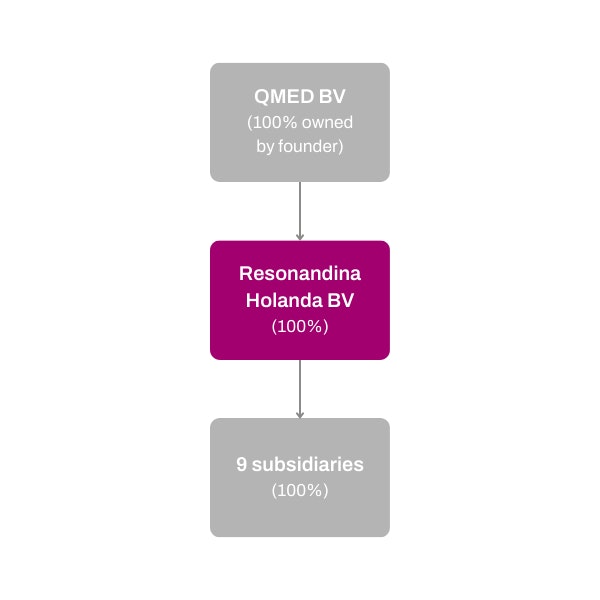
Resonandina Holanda B.V. is fully owned by QMED B.V., a private holding company controlled by founder and CEO Floriaan van Bemmelen and his family.

This ownership structure ensures clear governance and long-term strategic continuity. Strategic decisions, capital allocation, and expansion plans are determined at holding level. Since its founding in 2015, the company has grown under founder-led management while progressively professionalizing its organization.

Group structure

Investors participate in a bond issued by Resonandina Holanda B.V., the Dutch holding entity.

The holding company finances and supports its operational subsidiaries in Latin America, the Caribbean and the USA. These subsidiaries execute local hospital contracts and operate the medical equipment under long-term lease agreements.

The group structure reflects Resonandina’s international operating model, combining centralized financial management at holding level with local operational execution in the respective markets.

Developments at company name since the last crowdfunding

The company’s development over the past year reflects continued growth and further professionalization. Key developments include:

  • Financial performance: EBITDA increased from approximately €1.8 million in 2024 to around €2.5 million in 2026. For 2026, EBITDA is expected to be approximately €3.5 million.
  • Project delivery: In 2025, five projects were successfully installed. Three additional installations were postponed and are expected to be completed in 2026. These timing shifts affect short-term results but do not change the overall project pipeline.
  • Strengthened capital base: 2025 solvency increased to approximately 22%, supported by retained earnings and the formalization of a €2 million subordinated loan.
  • Market expansion: In cooperation with Varian, steps have been taken to explore opportunities in underserved regions in Mexico and the United States, complementing the established presence in the Americas.
  • Organizational development: The team has expanded and internal processes have been further professionalized, reducing operational dependency on individual management members and strengthening scalability.

Together, these developments indicate steady operational growth and increasing maturity of the organization compared to earlier funding rounds..

Use of funds

The funds raised in this round will be used to finance the installation of a Linear Accelerator (Linac) in a hospital in Cusco, Peru, or alternatively in a similar underserved region in Peru.

Cancer remains one of the leading causes of death globally, and access to radiotherapy infrastructure remains uneven in many regions of Latin America. The installation of this Linac in Cusco strengthens local cancer treatment capacity and reduces the need for patients to travel long distances for care.

A Linac is advanced radiotherapy equipment used in cancer treatment. It generates high-energy X-rays that are precisely directed at tumors, enabling targeted destruction of cancer cells while minimizing damage to surrounding healthy tissue. The installation of this equipment expands local radiotherapy capacity and improves access to modern cancer treatment.

The financing amount for this round is up to €2,500,000. Depending on the total amount raised, the following funding scenarios are possible:


Icon 1

Minimum scenario

(Minimum funding threshold of €500,000 for the financing round)

In this scenario, the funds will be used to co-finance the Linac project in Peru alongside additional group financing. 

Use of funds:

  • 100% – Equipment acquisition (partial financing)
    Contribution to the purchase of the Linear Accelerator.

This scenario enables the structured implementation of the Linac project and the start of local radiotherapy services.

Icon 2

Maximum scenario

(Maximum financing amount of up to €2,500,000 in the financing round)

In this scenario, the funds will be used to fully finance the Linac project, including acquisition and all related project costs.

Use of funds:

  • 60% – Full equipment acquisition
    Purchase of the Linear Accelerator.
  • 20% – Working capital during ramp-up phase
    Operational buffer during the initial months of project execution and financial costs.
  • 15% – Installation and technical implementation
    Transport, customs clearance, engineering, and certified installation.
  • 5% – Commissioning and training
    System integration, testing, and training of local staff in collaboration with OEM partners.

This scenario allows Resonandina to fully implement the Linac project within its established medical lease structure and expand radiotherapy capacity in the region.

Financial figures & growth

Actual and planned figures

Get an insight in to the company's financial figures, such as turnover and earnings development. Learn more about the growth forecast.

Login Sign up


-----End of marketing content-----

Security and risks

Security

The following collaterals/guarantees (further decribed in the KIIS) are provided:

  • pledge on the Linac device to be owned by Resonandina Peru S.a.C. and leased to a hospital/clinic in Peru;
  • pledge on the claims of Resonandina Peru S.a.C. against the hospital/clinic in Peru, to which the aforementioned Linac device will be leased;
  • guarantee provided by Resonandina Peru S.a.C..

The value of collaterals/guarantees can fluctuate, especially in the event of default, potentially resulting in diminished return. There is a risk that the collaterals/guarantees cannot be realized.

Risks

Investing in growth companies always involves risks. Below you can find the detailed list of risks related to this investment, as described in the Key Investment Information Sheet (KIIS). Please review this information carefully before making your investment decision.


  • The project owner's plans assume that the Resonandina Group’s pay-by-use concept will enable sufficient income to be generated from the leasing of the medical imaging devices, so that the investment of the bondholders can be fully repaid. The assumptions made by the project owner regarding the number of uses (patients) based on the pay-by-use concept could prove to be inaccurate. Especially, as cash flows are only guaranteed for the minimum volume guarantee agreed with the hospital, there is a risk that cash flows will not occur as planned. This risk is hedged by long-term lease agreements with hospitals to ensure permanently stable cash flows and the agreed securities - nevertheless, there is a remaining residual risk that the revenues might not occur as planned, in terms of the current assumptions, during the term. This could make it difficult for the project owner to properly service the claims of the bondholders within the term of the bond. In the worst case this can mean for the bondholders that interest payments and or the repayment are cancelled in whole or in part. In addition, the Resonandina Group may be unable to raise sufficient capital for the purchase of medical imaging devices in the future and thus conclude sufficient lease agreements. This can make the business activities of the project owner and its subsidiaries practically impossible. This can mean for the bondholders that interest payments and repayments are cancelled in whole or in part.
  • When purchasing medical diagnostic imaging devices, the Resonandina Group works closely with OEMs (Original Equipment Manufacturer) and third-party suppliers as well as local providers for rigging, shipment, construction and engineering. There is a residual risk that the suppliers could default or delay. In the event of the insolvency of the suppliers, for example, there would be a risk that the project owner would have only limited or no options to procure quickly medical diagnostic imaging devices. This could lead to delay of the installations and thus to temporary reductions in the project owner's income and make it more difficult for the project owner to properly service the claims of the bondholders.
  • The Resonandina Group works closely with transportation, maintenance and service companies, suppliers and customers under long-term contracts to ensure continuous and stable operations. Nevertheless, a residual operational risk remains, which is based, for example, on the default of the parties mentioned above and could make it difficult for the project owner to properly service the claims of the bondholders.
  • Once the medical imaging devices has been commissioned in the hospitals, the period of operation starts. The risk of technical defects during the term of the bonds is mostly covered by the long term maintenance and service arrangements with the suppliers. In addition, equipment has standard supplier warranties. Nevertheless, there remains a residual risk that technical defects might not be remedied despite the maintenance and service agreements and may not be covered by the product warranties, which could have a negative impact on the Resonandina Group’s business activities, resulting in a loss or partial loss of the capital invested and/or the return for the bondholders.
  • There is a structural risk resulting from the fact that the projects of the Resonandina Group usually involve several financing parties. As the claims of these parties usually have the same priority as the claims of the project owner and/or its subsidiaries, there is a risk that the proceeds to be distributed to all financing parties might not be sufficient. This can mean for the bondholders that interest payments and repayments are cancelled in whole or in part.
  • There is a currency risk as the Resonandina Group attracts its loans in Euro’s (from 2024 also in Dollars), pays its medical equipment in dollars and gets its revenues for 70% in dollars and 30% in the respective local currency, where revenues are generated. This means that investors are exposed to a currency risk as the Resonandina Group is exposed to exchange rate fluctuations which may reduce the cash flows in Euro and thus the yield of the bonds.
  • The management team of the Resonandina Group has extensive growth capital and project finance experience, including in respect of leasing and selling/purchasing of diagnostic medical devices. Although the management team has extensive experience in the field, there is a residual risk if one or more members of the management were to leave the Resonandina Group. This would likely have have a negative impact on the business activities of the Resonandina Group and thereby on the project owner’s operations. Furthermore, the project owner has a management risk because there is a board of three and just one CEO/Managing Director. Any absence of the CEO/Managing Director could slow down the decision-making process, which could lead to lower income for the project owner from its business activities and have a negative impact on the project owner's net assets, financial position and results of operations. For the bondholders this may mean that interest and redemption payments are not made in whole or in part.
  • To the project owner’s knowledge, there are no lawsuits or other legal proceedings pending. The likelihood of such proceedings occurring in the future is considered to be low, as the installation and operation of the devices is under the responsibility of the manufacturers and hospitals. Nevertheless, there remains a residual risk that any proceedings may be initiated against the project owner or the project owner’s subsidiaries or that legal changes may arise (e.g. that the projects may require a permit in the future) that could have a negative impact on the Resonandina Group’s business activities. For the bondholders this may mean that interest and redemption payments are not made in whole or in part.
The project owner's business is in accordance with Article 2(1), point (a), of Regulation (EC) No 1893/2006 of the European Parliament and of the Council3 (“Regulation”) to engage in rental and leasing activities (see Classification of Section N in accordance with Annex 1 to the Regulation). The business case is for a substantial part based on rapidly growing demand for the leasing of medical diagnostic imaging devices by hospitals that are unable to purchase such devices themselves due to the high prices. Nevertheless, if the Resonandina Group is unable to conclude the lease agreements with hospitals, this might mean that the revenues will not occur as planned, in terms of the current assumptions, during the term. This could make it difficult for the project owner to properly service the claims of the bondholders.

The bondholders bear the full risk of the Resonandina Groups’s insolvency, i.e., the risk that the project owner and/or one or more of its subsidiaries is temporarily or permanently unable to meet its payment obligations on time. Especially in the context of insolvency proceedings, the bondholders could suffer a total loss. The following specific occurrences could lead to this:

  • (a) (serious) change in the macroeconomic situation,
  • (b) mismanagement,
  • (c) lack of experience,
  • (d) fraud,
  • (e) financing that is not in line with the business purpose,
  • (f) unsuccessful introduction of the project owner’s service,
  • (g) lack of cash flow.

There is a risk that, as a result of all of the risks mentioned in Part C, return may be lower than expected, delayed or no principal or interest payments may flow from the project. Furthermore, the value of the return could be reduced by inflation. If the inflation rate is higher than the interest rate on bonds, the return on bonds will be negative.
The bonds will be issued in Euro and the interest payable on the bonds will also be calculated and paid in Euro. For this reason, investors who have earned income or assets in a currency other than Euro or who do not require the income from the investment in the bonds to be denominated in Euro are exposed to a currency risk because they are exposed to exchange rate fluctuations which may reduce the yield of the bonds. Furthermore, in the event of a necessary sale of the bonds for the bondholder, additional costs (transaction costs such as consultancy fees) may arise which reduce the return. The individual return of the respective investor may vary in individual cases and depends on the individual tax situation in each case, which may lead to a reduction in the return.

A temporary or permanent failure of the platform of the crowdfunding service provider may result in the crowdfunding service provider being unable to provide its services. This may result in investors being unable to subscribe to the offered bonds or in delays in payment transactions, e.g. in the transfer of invested funds to the project owner or in the repayment of investor funds due to a revocation or resolving condition. Since the invested funds are held in an escrow account and the crowdfunding service provider does not dispose of the funds at any time, a loss of the invested capital solely due to a failure of the platform of the crowdfunding service provider is unlikely. Furthermore, the management of the investor claims and the collateral of the bonds issued under the crowdfunding is carried out by an independent third party in the form of a trust foundation under Dutch law. This is Stichting Custodian Agent OPC, registered in the Dutch Commercial Register under registration number: 63904179 (hereinafter "Custodian OPC"). Should the Custodian OPC also unexpectedly become insolvent or bankrupt under Dutch law or have to discontinue its services for other reasons, the contractual relationship between the project owner and the bondholders regarding the subscribed investments will nevertheless continue to exist. The project owner will then appoint a new party to manage the financing and the collateral.

The bonds have a fixed contractual term. The transfer of the bonds is also technically restricted in that a transfer is only possible to digital safe deposit boxes registered with the project owner or the registrar. The "Registrar" that maintains the e-securities register is Smart Registry GmbH, registered in the commercial register of the Charlottenburg District Court in Berlin under registration number HRB 234468 B. "Digital safe deposit box" is an IT application used to store public keys and private keys and to interact with technology, the functionalities of which make it possible to hold and transfer e-securities. The securities are currently not tradable on a stock exchange, nor is there a liquid secondary market. Even if the securities are included in trading on one or more trading platforms for securities, it is uncertain whether trading of the bonds will actually develop. The risk that the bondholder is unable to find a buyer for the bonds or can only sell them for a price that he considers to be too low is borne solely by the bondholder. The bonds may also turn out to be completely illiquid. A sale of the bonds by the bondholder may therefore only be possible to a limited extent. There is a risk that the bonds cannot be sold or can only be sold at a financial loss. For bondholders with short-term capital requirements, this means that they may not be able to dispose of the capital invested at the desired time, especially as bondholders do not have an ordinary right of termination during the term.

The following securities-related risks also exist:

i) No rights of influence and participation

The bonds themselves only establish claims under the law of obligations against the project owner and do not grant any participation, involvement and/or voting rights in or at the shareholders' meeting of the project owner. Shareholder resolutions may be passed at the shareholders' meeting of the project owner which may have a detrimental effect on the individual bondholders. The bondholders have no opportunity to influence the business activities of the project owner. This also applies to the utilisation of the capital raised through the issue of the bonds. In particular, bondholders do not have the opportunity to terminate loss-making business activities of the project owner before the contributed capital has been utilised. For bondholders, this can lead to the total loss of the capital invested.

ii) Deterioration of the conditions by majority resolution

According to the issue terms, these can also be adjusted during the term of the bonds if the necessary votes of the bondholders have been obtained by majority resolution in accordance with the issue terms. In this respect, the individual bondholder bears the risk that changes to the issue terms may be made against his will on the basis of the majority resolution of the bondholders, which may be to his disadvantage (e.g. lower interest rate, extended term or waivers).

iii) Technology and database risks

The technology and all related technological components and regulated services (e.g. digital custody, e-securities register management) are still at an early stage of technical development. There is a risk for bondholders that this technology may be subject to technical difficulties or that its functionality may be impaired by external influences. A partial or complete collapse of the electronic decentralised database (hereinafter ‘e-database’) relevant to the e-securities could make it temporarily and permanently impossible for bondholders to access their e-securities. There is a risk of attacks against the network or the e-database used. Various types of attacks are conceivable. These attacks could render the network or e-database unusable, making it impossible for bondholders to transfer the e-securities. If the network or e-database becomes completely unusable, there is a risk that bondholders will no longer have access to their digital safe deposit boxes. In the worst case scenario, this could lead to the irretrievable loss of the e-securities.

The project owner offers the bondholders a technical solution via an authorised e-securities custodian that serves to hold, store and dispose of e-securities. There is a risk that this solution is flawed and/or particularly vulnerable to possible hacker attacks. As a result, bondholders may be temporarily or permanently unable to access their e-securities, which in the worst case could lead to the irretrievable loss of the e-securities. Neither the e-securities custodian nor the project owner will take over the administration in the sense of the ongoing exercise of the rights and obligations arising from the e-securities.

The risks listed above are not the only risk factors affecting the operations of the project owner. Also, other risks and uncertainty factors that the project owner currently does not identify or considers presently irrelevant may have an integral effect on the business operations, business results, and financial standing of the project owner.

Documents

Investment related documents

Log in for more information.

Updates

There are currently no updates available.

This section will be regularly updated with new, project-relevant information as the financing progresses. To be informed about new updates in a timely manner, subscribe to our newsletter.

Invesdor is a Eurocrowd platform member.

Ausgezeichnet als Top-Innovator 2021

Winner of the Golden Bull as the best
Crowdfunding platform 2023.

ECSP lizensiert

Invesdor is licensed under the
ECSP regulation of the EU.