Marketing content

Bluespoon at a glance

Problem

Problem
Many tableware products in online retail are either positioned in the high-priced premium segment or in the highly price-driven low-cost segment with little focus on design and product series diversity.
[Learn more]

Solution

Solution
With its brand Sänger, Bluespoon develops and sells design-oriented tableware and table accessories with a balanced price-performance ratio through online marketplaces and its own online shop.
[Learn more]

Market

Market
The market for tableware and table accessories is an established consumer goods market with stable demand, in which online retail continues to gain importance.
[Learn more]

Competetion

Competition
Sänger is positioned in the mid-price segment between premium manufacturers and strongly price-driven offers, differentiating itself through proprietary designs and clearly structured product series.
[Learn more]

Business model

Business model
Bluespoon develops its own tableware collections and distributes them through major online marketplaces as well as its own online shop.
[Learn more]

Use of funds

Use of funds
The financing will support the expansion of the Sänger brand by increasing inventory levels and broadening the product range.
[Learn more]

Important notice: Every investment involves risks and may lead to the complete loss of the invested capital. Find more information here.

Nikolaj Pecherski, founder and CEO, Bluespoon GmbH

"With the Sänger brand, we develop tableware and table accessories that combine modern design with an attractive price-performance ratio. Our products primarily reach customers through major online marketplaces as well as through our own online shop.

Since our founding, we have successfully expanded our product portfolio – not only in tableware, but also with a wide range of complementary products such as pasta dryers, drinking glasses, picnic baskets, placemats, serving platters, bowls, carafes, cutlery, and other accessories for the kitchen and the set table. Through this targeted expansion of our assortment, we have continuously developed the Sänger brand and established a strong position in online retail.

With the current financing, we aim in particular to further expand our product range and introduce additional product series."

Nikolaj Pecherski, Founder & Managing Director, Bluespoon GmbH

Investment information

Days to invest:
14
Investing round ends:
06/04/2026
Type:
Bond
Subordinated:
no
Invested so far:
€130,250.00
Price per bond:
€250.00
Min offer:
1 Unit
Maximum issue size:
€750,000
in 3,000 Units
Interest:
quarterly
Repayment:
quarterly
ISIN:
DE000A46Z9H2
Broker:
Oneplanetcrowd International B.V
License:
ECSPR

About Bluespoon

Company profile

Sänger stands for design-oriented tableware and products for the set table. The brand is developed and managed by Bluespoon GmbH, an e-commerce company based in Cologne, Germany, specializing in the development and online distribution of tableware and table accessories.

Many households are looking for stylish tableware that can be used both in everyday life and on special occasions. However, well-designed products are often positioned in the premium segment, while lower-priced alternatives frequently offer less durability or less appealing design.

With the Sänger brand, Bluespoon aims to combine modern design, everyday functionality and an attractive price-performance ratio. The product range includes tableware sets, mugs, bowls, glasses and other items for the kitchen and the set table. Most designs are developed in-house and marketed under the Sänger brand.

The Bluespoon GmbH was founded in 2015 and is led by Nikolaj Pecherski, who controls the company through Pecherski GmbH.

Developments since the previous financing round with Invesdor

Learn more about the company’s developments since the previous financing round here.

Pottery craftsmanship

Company information

Company: Bluespoon GmbH
Management: Nikolaj Pecherski
Company registration number: HRB 86329
Year founded: 2015
Address: Toyota-Allee 33
50858 Cologne
Germany
Industry: E-commerce / Kitchen & Household (tableware and table accessories)
Employees 17
Location: Cologne (Germany)
Website: saenger-geschirr.de
Social Media:

Products

Under the Sänger brand, Bluespoon GmbH develops and sells products for the set table. The core of the portfolio consists of tableware collections made from stoneware and porcelain, complemented by drinking glasses, placemats, coasters and other selected kitchen and table accessories. This creates a coherent product range for customers who value design, quality and everyday usability.

The collections reflect different design styles and color concepts, combining aesthetic design with functional everyday practicality. Colors, textures and surfaces give the products a distinctive character and create a strong brand recognition within the Sänger portfolio.

A selection of SÄNGER stoneware and porcelain tableware:

Bowls

Pasta drying rack

Christmas table setting

Picnic

In-house design development and protected product series

A key part of the product strategy is the in-house development of designs and tableware collections. The company continuously observes trends in table culture and interior aesthetics and translates these insights into new product lines.

The designs are developed internally and legally protected. In total, Bluespoon holds more than 700 registered design and trademark rights, protecting the visual appearance of its products and helping differentiate the Sänger brand in the market.

Production and quality control

Production is carried out through long-term partners in Asia. Manufacturing is coordinated by local partners who supervise multiple production facilities and conduct quality inspections on site.

In addition, the products undergo a further quality check after arriving in Germany. The aim is to ensure consistent product quality as well as reliable product availability.

Continuous expansion of the product range

The product portfolio is regularly expanded. New tableware series are first tested with selected core products and, if demand proves positive, gradually expanded.

This structured product development approach allows the company to further develop successful collections while continuously introducing new designs.

Business model

Set table

Family time

The business model of Bluespoon GmbH is based on the development of proprietary tableware collections under the Sänger brand and the distribution of these products through digital sales channels. The goal is to offer design-oriented tableware and products for the set table at an attractive price-performance ratio and to scale efficiently through e-commerce platforms.

Development of new product series

A key component of the business model is the continuous development of new product series. Bluespoon monitors current trends in table culture, kitchen products and home & living, translating them into market-ready collections with a clear design focus.

New series typically start with selected core products such as dinner plates, dessert plates and bowls. If these products perform well in the market, the company gradually expands the collections with additional items such as pasta bowls, mugs or serving dishes. In this way, the product range is developed step by step, driven by demand and with a focus on sustainable growth.

Tableware collection

Procurement and production

Production is carried out through long-standing partners in Asia. By working with specialized manufacturers, the company is able to manage design, quality and cost structures in a targeted way.

The products are manufactured in larger batches and then distributed from the warehouse in Germany to the respective sales channels.

Sales through online platforms and the company’s own shop

Sales are primarily generated through major online marketplaces as well as through the Sänger brand’s own online shop. Key platforms include Amazon, Otto, XXXLutz and Home24, allowing the company to reach a broad customer base.

Being present on multiple platforms enables the company to quickly test new products in the market and further develop them based on sales performance, demand trends and customer feedback.

Data-driven product portfolio management

A key element of the business model is the data-driven analysis of product performance. Based on sales figures and customer feedback, decisions are made about which products should be further expanded and which series should be discontinued.

This structured portfolio management approach allows the company to scale successful products in a targeted way while limiting the risks associated with introducing new product lines.

Market

Glasses

Cups

Decoration

Bowls

Stable market for tableware and table accessories

With its brand Sänger, Bluespoon GmbH operates in the market for products related to the set table. This market includes tableware, glasses, cutlery and other kitchen and table accessories made from materials such as porcelain, ceramic and glass.

The market for these so-called GPK products (glass, porcelain, ceramics) has been an established consumer goods market with stable demand for many years. Tableware and kitchen accessories are part of the basic equipment of households and are regularly supplemented or replaced.

For the German-speaking region (Germany, Austria and Switzerland), the market volume for table and kitchen accessories is estimated at around €1.35 billion in 2025. By 2029, moderate growth to approximately €1.52 billion is expected.

Growing importance of online retail

An increasing share of this market is handled through online sales channels. Digital platforms allow customers to easily compare products, view reviews and complement existing tableware collections.

For companies like Bluespoon, online retail creates the opportunity to test new products quickly in the market and distribute a broad product range efficiently.

Positioning of the Sänger brand

With the Sänger brand, the company is positioned in the mid-market segment, targeting customers who are looking for modern design, quality and everyday usability at a fair price. Through different sub-brands – including the “Premium Collection” and the “Value Collection” – the company addresses distinct price and customer segments. This positioning places Sänger strategically between premium brands in the higher price segment and strongly price-driven entry-level offers.

Competition and Unique Selling Points

Competitive landscape in the tableware and table accessories market

The market for tableware and table accessories is characterized by a wide range of suppliers. In addition to traditional premium brands, numerous providers operate in the mid- and lower-price segments, including large retail chains as well as e-commerce brands.

Premium brands such as Villeroy & Boch, Rosenthal or ASA Selection position themselves with high-quality branded products and correspondingly higher prices. At the same time, major retail chains and home furnishing brands such as IKEA, H&M Home or Zara Home offer more price-oriented alternatives.

In the e-commerce environment, there are also specialized online brands that primarily distribute their products through marketplaces. Direct competitors in the German-speaking online retail market include brands such as Pure Living and moritz & moritz, which also focus on tableware and kitchen accessories.

Positioning of the Sänger brand

With the Sänger brand, Bluespoon GmbH positions itself in the mid-price segment between premium brands and strongly price-driven offerings. The target group consists of customers looking for modern design and a cohesive look for the set table while expecting a balanced price-performance ratio.

Key differentiating factors

The Sänger brand differentiates itself from competitors through the combination of several factors:

  • In-house developed designs
    A large part of the product collections is developed internally. The designs are legally protected and allow for clear visual differentiation in the market.
  • Broad product range for the set table
    The portfolio includes a wide range of products that can be combined into complete tableware collections. This allows customers to create a consistent table setting across multiple product categories.
  • Strong online presence
    Through sales via major online platforms as well as its own shop, the company reaches a broad customer base and can introduce new products to the market quickly.
  • Data-driven product development
    The development of the product portfolio is based on sales data and customer feedback from sales channels. Successful series are expanded in a targeted way, while products with lower demand are adjusted or replaced more quickly.

Company structure

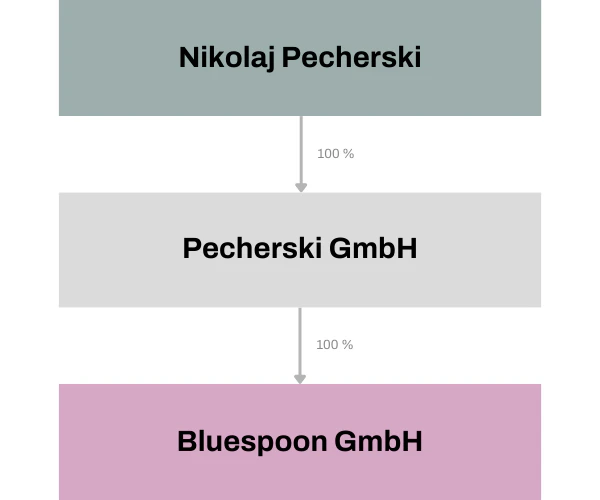
The Bluespoon GmbH is an owner-managed company. All shares are held by Pecherski GmbH.

Pecherski GmbH is fully owned by Nikolaj Pecherski, who is also the Managing Director of Bluespoon GmbH. As a result, the strategic and operational responsibility for the company lies with its founder.

This structure enables clear decision-making and supports a long-term orientation of the company’s development.

Developments since the previous financing round

Since the previous financing round via Invesdor, Bluespoon GmbH has further developed its operations and continued to expand the Sänger brand as its core product line. In recent years, the product range has been continuously expanded and the company has strengthened its presence on key online sales platforms.

At the same time, internal processes as well as procurement and logistics structures have been further professionalized.

The company has also progressed financially. According to preliminary figures for 2025, Bluespoon increased both revenue and earnings compared to the previous year. At the same time, inventory levels and supplier liabilities were reduced, improving the company’s balance sheet structure.

An important milestone was also the full and scheduled repayment of the loan from the first financing round via Invesdor.

With the current financing round, the company plans to expand its inventory and further develop the Sänger product portfolio in order to support continued growth through its existing online sales channels.

Expansion of the SÄNGER brand towards Home & Living

With the Sänger brand, the company has successfully established itself in the segment of tableware and products for the set table. The expansion into adjacent product areas within the Home & Living segment builds on this established brand, its existing customer base and proven sales channels.

Additional product categories such as coffee-to-go mugs, storage containers, lunch boxes, carafes and other kitchen and everyday accessories expand the existing product range while offering potential for cross-selling, higher basket values and a broader customer reach.

These product categories may also unlock additional margin potential while leveraging the brand’s existing market presence. In this way, further growth can be generated by strategically extending the existing business model into adjacent product categories.

Back to top ▲

Management

Nikolaj Pecherski, founder and CEO

Nikolaj Pecherski
Founder & Managing Director

Nikolaj Pecherski is the founder and Managing Director of Bluespoon GmbH. He is responsible for the strategic development of the company as well as the establishment and further development of the Sänger brand.

Before founding Bluespoon, he gained leadership experience at Lidl, where he worked in area management and sales. His entrepreneurial journey began during his studies, when he started developing products in the kitchen and household segment and selling them through online platforms.

Today, he is primarily responsible for product development, procurement and the strategic direction of the company.


Justin Döring, Head of Marketing, Sales and Operations

Justin Döring
Head of Marketing, Sales & Operations

At Bluespoon GmbH, Justin Döring is responsible for marketing, sales and operational processes. His focus is on further developing the company’s online sales channels and optimizing marketing and e-commerce activities through data-driven approaches.

He has many years of experience in digital marketing and sales. Before joining Bluespoon, he worked in marketing and sales roles and gained experience at companies such as Nielsen as well as in various positions in digital marketing and sales.

At Bluespoon, he primarily drives the further development of the Sänger brand and the expansion of the company’s online distribution channels.

Use of funds

The financing will support the further development of the Sänger brand as well as the expansion of the product portfolio. A key component of the Bluespoon GmbH business model is the procurement of inventory that is sold through various online sales channels.

The financing is primarily intended to increase inventory levels and broaden the product range. In addition, the company aims to gradually develop the Sänger brand beyond tableware into a broader Home & Living lifestyle brand.

This will enable the company to respond more quickly to demand, introduce new product lines and improve the availability of existing products.

The financing volume ranges from a minimum of €250,000 to a maximum of €750,000. Depending on the amount of capital raised, the following scenarios may apply:

Icon 1

Minimum scenario

(Minimum financing threshold of €250,000 for this financing round)

In this scenario, the funds will primarily be used to build additional inventory in order to increase the availability of existing Sänger brand products.

Use of funds:

  • 70% – Procurement of goods and inventory
    Expansion of inventory levels and ensuring product availability.
  • 20% – Product range expansion
    Introduction of new tableware collections and expansion of existing product lines.
  • 10% – Operational reserve
    Buffer for logistics, transport costs and operational flexibility.

Icon 2

Maximum scenario

(Maximum financing volume of up to €750,000 in this financing round)

If the financing is fully subscribed, the company will be able to further accelerate the expansion of its product portfolio in addition to increasing inventory levels, enabling new product lines to be established more quickly in the market.

Use of funds:

  • 65% – Procurement of goods and inventory
    Financing larger order volumes and expanding inventory levels.
  • 25% – Product range expansion
    Development and market launch of new tableware collections.
  • 10% – Operational reserve
    Support for logistics, transportation and operational processes.

Financials

Current and projected financial figures

Gain insight into the company’s financial performance, including the development of revenue and earnings. Learn more about the company’s planned growth trajectory.

Login Sign up

Bonus

Bonus 1

€500 to €2,250 investment:
10% discount*

All investors who invest between €500 and €2,250 will receive a 10% discount on all online orders until April 30, 2027.

Bonus 2

€2,500 to €4,750 investment:
20% discount*

All investors who invest between €2,500 and €4,750 will receive a 20% discount on all online orders until April 30, 2027.

Bonus 3

From €5,000 investment:
30% discount*

All investors who invest €5,000 or more will receive a 30% discount on all online orders until April 30, 2027.

Note:

*Bonuses for investors will only be granted if the investment project is successfully completed and after the financed amount has been paid out to the company – expected to be approximately four weeks after the completion of the financing.

Only one voucher can be assigned per user profile. Multiple investments will be combined.

Your voucher code is expected to appear in your Invesdor portfolio starting from April 30, 2026.

The voucher is valid without a minimum order value and can also be applied to already discounted items.


-----End of marketing content-----

Securities and risks

Securities

Nikolaj Pecherski, as Managing Director of the project owner, has undertaken, within the framework of a guarantee, to be liable to the bondholders for the non-payment of interest and/or repayments from the bonds in the amount of 100% of the actual subscription amounts placed, thereby up to a maximum of €750,000.
The value of guarantees can fluctuate, especially in the event of default, potentially resulting in diminished return.

Risks

An investment in growth-oriented companies is always associated with risks. Below you will find a detailed description of the risks related to this investment, as outlined in the Key Investment Information Sheet (KIIS). Please read this information carefully before making an investment decision.


i) Project dependencies such as financing, legal aspects, licensing, copyrights:

The crowdfunding offer may raise less capital than planned. This may result in the project owner not being able to successfully implement its planned project due to a lack of funds. This would lead to lower income for the project owner from its business activities and have a negative impact on its net assets, financial position and results of operations. This may have the consequence that the claims from the bonds cannot be fulfilled or cannot be fulfilled in the planned amount. In the worst case, there is a total loss of the capital invested.

Violations of legal or regulatory requirements can lead to measures by authorities (fines, closure of businesses, etc.). This would lead to lower income for the project owner from its business activities and have a negative impact on the project owner's net assets, financial position and results of operations. For the holders of the bonds (hereinafter "bondholders"), this may mean that interest and redemption payments are not made in whole or in part.

As the products are produced in China, functioning supply chains are strategically important for the project owner's business. There is a risk that legal or regulatory requirements in relation to the aforementioned supply chains may change. This may lead to higher costs for the project owner and thus have a negative impact on the project owner's net assets, financial position and results of operations. For the bondholders, this may mean that interest and redemption payments are not made in whole or in part. Even though designs developed in-house are protected by trademark law (> 700 registered trademark rights) and also enforced with the involvement of a specialized lawyer, there is a risk that the project owner's product designs could be challenged, which would lead to costly legal proceedings. This would have a negative impact on the project owner's financial position and results of operations. For the bondholders, this may mean that interest and redemption payments are not made in whole or in part.

ii) Occurrence of adverse scenarios with negative impacts:

The project owner's plans assume that the production of the cookware and dinnerware in China and the shipment to Germany will take place frictionless as in the previous years. The assumptions made by the project owner in the planning regarding the production and delivery of cookware and dinnerware products could prove to be incorrect. Scenarios such as a pandemic and/or political tensions could lead to supply chain problems, meaning that the project owner may not be able to procure the cookware and dinnerware products in the required quantity and/or quality and sell them at a profit. For the bondholders, this could mean that interest and redemption payments are not made in whole or in part.

iii) (Technological) development of competitors or competing products:

The project owner may be unable to compete effectively with existing and potential new competitors or to respond to changes in the competitive environment, which may adversely affect its business performance. In particular, risks to the project owner's business could arise if these competitors expand their business more successfully than the project owner, which could worsen the project owner's business situation.

iv) Risks associated with the project owner:

Although the project owner is not an early-stage company, it is nevertheless in a growth phase and the financing of such a company is associated with specific risks. If the already established business idea is no longer accepted by the market in the future or if the planned business development cannot be implemented as hoped, there is a risk of the project owner becoming insolvent. The company's success depends on various factors, such as financing, the team, specialists and consultants, the market environment, technological developments, property rights, legal framework conditions, competitors and other factors. For the bondholders investing in a company in a growth phase, this increases the risk that they will lose their invested capital.

The project owner has a management risk because the sole Managing Director Nikolaj Pecherski is also indirectly holding 100 % of shares in the project owner. Any absence of the Managing Director could slow down the decision-making process, which could lead to lower income for the project owner from its business activities and have a negative impact on the project owner's net assets, financial position and results of operations. For the bondholders this may mean that interest and redemption payments are not made in whole or in part.

The project owner also has a structural risk as the retention of the existing shareholder loan is conditional. Any non-fulfilment of the respective conditions would have a negative impact on the project owner's net assets, financial position and results of operations. For the bondholders this may mean that interest and redemption payments are not made in whole or in part.

There is a risk of management errors on the part of the project owner. Technical, legal or economic misjudgments may occur. It also cannot be ruled out that the shareholder structure may change in the future and that third parties may gain a controlling influence over the project owner. There is a risk that the project owner will not be able to retain or recruit the necessary number of qualified staff to implement the business strategy. Due to the loss of staff with the relevant key qualifications, there is a risk that specialist knowledge will no longer be available. If the key personnel cannot be permanently replaced by qualified staff, this can have a significant negative impact on the economic development of the project owner. This could reduce the amount of interest payments to bondholders and the repayment of the investment amount, or these could be cancelled. In the worst case, there is a total loss of the capital invested.

There is a risk that the project owner will get negative media attention. This may lead to significant sales decline and losses for the project owner because there is insufficient demand for the project owner’s products because of the negative media attention. In the worst case, this can also lead to a total loss of the capital invested.

In accordance with Article 2(1)(a) of Regulation (EC) No 1893/2006 of the European Parliament and of the Council 5(Regulation), the project owner's business is best described by the classification of Section G in Annex 1 of the Regulation.

The inflation and the consequences of the war in Ukraine and the Middle East are having a dampening effect on the market for crockery and kitchen accessories and a further continuation or even increase in inflation may lead to a worsening of market conditions, which could reduce demand for the project owner’s range of products and thus result in a total loss of the capital invested. In addition, the current geopolitical risks (risk of disruption of the global supply chain) due to the war in the Middle East could significantly restrict the aforementioned market and make the business activities of the project owner effectively impossible due to the high dependence on stable supply chains, especially in China incl. moderate transport rates. Any prolonged disruption of the global supply chain can in the worst case lead to a total loss of the capital invested.

The bondholders bear the full risk of the project owner’s insolvency, i.e., the risk that the project owner is temporarily or permanently unable to meet its payment obligations to the bondholders and or third parties on time. Especially in the context of insolvency proceedings, the bondholders could suffer a total loss. The following specific occurrences could lead to this:

  • (a) (serious) change in the macroeconomic situation,
  • (b) mismanagement,
  • (c) lack of experience,
  • (d) fraud,
  • (e) financing that is not in line with the business purpose,
  • (f) unsuccessful introduction of the project owner’s service,
  • (g) lack of cash flow.

There is a risk that, as a result of all of the risks mentioned in Part C, return may be lower than expected, delayed or no principal or interest payments may flow from the project. Furthermore, the value of the return could be reduced by inflation. If the inflation rate is higher than the interest rate on bonds, the return on bonds will be negative.

The bonds will be issued in Euro and the interest payable on the bonds will also be calculated and paid in Euro. For this reason, investors who have earned income or assets in a currency other than Euro or who do not require the income from the investment in the bonds to be denominated in Euro are exposed to a currency risk because they are exposed to exchange rate fluctuations which may reduce the yield of the bonds. Furthermore, in the event of a necessary sale of the bonds for the bondholder, additional costs (transaction costs such as consultancy fees) may arise which reduce the return.

The individual return of the respective investor may vary in individual cases and depends on the individual tax situation in each case, which may lead to a reduction in the return.

A temporary or permanent failure of the crowdfunding platform or the payment service provider specified in Part D, letter d) may lead to the temporary cancellation of interest and repayments. Since the crowdfunding service provider at no time acquires possession or ownership of the subscription amounts of the investors or of the interest and repayment amounts and since the payment service provider merely acts as trustee for the project owner as trustor, a loss of the invested capital based solely on a failure of the platform or the payment service provider is unlikely.

The bonds have a fixed contractual term. The transfer of the bonds is also technically restricted in that a transfer is only possible to digital safe deposit boxes registered with the project owner or the registrar. The "Registrar" that maintains the e-securities register is Smart Registry GmbH, registered in the commercial register of the Charlottenburg District Court in Berlin under registration number HRB 234468 B. "Digital safe deposit box" is an IT application used to store public keys and private keys and to interact with technology, the functionalities of which make it possible to hold and transfer e-securities. The securities are currently not tradable on a stock exchange, nor is there a liquid secondary market. Even if the securities are included in trading on one or more trading platforms for securities, it is uncertain whether trading of the bonds will actually develop. The risk that the bondholder is unable to find a buyer for the bonds or can only sell them for a price that he considers to be too low is borne solely by the bondholder. The bonds may also turn out to be completely illiquid. A sale of the bonds by the bondholder may therefore only be possible to a limited extent. There is a risk that the bonds cannot be sold or can only be sold at a financial loss. For bondholders with short-term capital requirements, this means that they may not be able to dispose of the capital invested at the desired time, especially as bondholders do not have an ordinary right of termination during the term.

The following securities-related risks also exist:

i) No rights of influence and participation

The bonds themselves only establish claims under the law of obligations against the project owner and do not grant any participation, involvement and/or voting rights in or at the shareholders' meeting of the project owner. Shareholder resolutions may be passed at the shareholders' meeting of the project owner which may have a detrimental effect on the individual bondholders. The bondholders have no opportunity to influence the business activities of the project owner. This also applies to the utilisation of the capital raised through the issue of the bonds. In particular, bondholders do not have the opportunity to terminate loss-making business activities of the project owner before the contributed capital has been utilised. For bondholders, this can lead to the total loss of the capital invested.

ii) Deterioration of the conditions by majority resolution

According to the Terms of Issue, these can also be adjusted during the term of the bonds if the necessary votes of the bondholders have been obtained by majority resolution in accordance with the Terms of Issue. In this respect, the individual bondholder bears the risk that changes to the Terms of Issue may be made against his will on the basis of the majority resolution of the bondholders, which may be to his disadvantage (e.g. lower interest rate, extended term or waivers).

iii) Technology and database risks

The technology and all related technological components and regulated services (e.g. digital custody, e-securities register management) are still at an early stage of technical development. There is a risk for bondholders that this technology may be subject to technical difficulties or that its functionality may be impaired by external influences. A partial or complete collapse of the electronic decentralised database (hereinafter ‘e-database’) relevant to the e-securities could make it temporarily and permanently impossible for bondholders to access their e-securities. There is a risk of attacks against the network or the e-database used. Various types of attacks are conceivable. These attacks could render the network or e-database unusable, making it impossible for bondholders to transfer the e-securities. If the network or e-database becomes completely unusable, there is a risk that bondholders will no longer have access to their digital safe deposit boxes. In the worst case scenario, this could lead to the irretrievable loss of the e-securities.

The project owner offers the bondholders a technical solution via an authorised e-securities custodian that serves to hold, store and dispose of e-securities. There is a risk that this solution is flawed and/or particularly vulnerable to possible hacker attacks. As a result, bondholders may be temporarily or permanently unable to access their e-securities, which in the worst case could lead to the irretrievable loss of the e-securities. Neither the e-securities custodian nor the project owner will take over the administration in the sense of the ongoing exercise of the rights and obligations arising from the e-securities.

The risks listed above are not the only risk factors affecting the operations of the project owner. Also, other risks and uncertainty factors that the project owner currently does not identify or considers presently irrelevant may have an integral effect on the business operations, business results and financial standing of the project owner.

Documents

Investment related documents

Log in for more information.

Updates

There are currently no updates available.

This section will be regularly updated with new project-related information during the course of the financing round. To receive timely updates, please subscribe to our newsletter.

Invesdor is a Eurocrowd platform member.

Ausgezeichnet als Top-Innovator 2021

Winner of the Golden Bull as the best
Crowdfunding platform 2023.

ECSP lizensiert

Invesdor is licensed under the
ECSP regulation of the EU.