i) Project dependencies such as financing, legal aspects, licensing, copyrights:
The crowdfunding offer may raise less capital than planned. This may result in the project owner not being able to successfully implement its planned project due to a lack of funds. This would lead to lower income for the project owner from its business activities and have a negative impact on its net assets, financial position and results of operations. This may have the consequence that the claims from the bonds cannot be fulfilled or cannot be fulfilled in the planned amount. In the worst case, there is a total loss of the capital invested. Violations of legal or regulatory requirements can lead to measures by authorities (fines, closure of businesses, etc.). This would lead to lower income for the project owner from its business activities and have a negative impact on the project owner's net assets, financial position and results of operations. For the holders of the bonds (hereinafter "bondholders"), this may mean that interest and redemption payments are not made in whole or in part.
The timely obtaining of building permits and financing commitments regarding each RFU to be constructed are strategically important for the achievement of the planned installation capacities and thus for the planned growth of the project owner. Even though currently 15 facilities have been sold to farmers and will be handed over by the end of 2026, corresponding to a sales volume of around € 67 million, initial problems with the construction of the RFUs due to delays in completion (e.g. due to delayed building permits or financing commitments) cannot be ruled out. Even though material costs are postponed in the event of delays, any delay in completion of the RFUs would have a negative impact on the planned cash flows, especially as personnel expenses cannot be adjusted quite flexibly. In addition, the booked revenues result largely from planning services rendered for the preparation of the RFUs, which will only become cash-effective once the respective building permit has been granted. There is a risk that these revenues may not be realised if building permits are not granted. For the bondholders, this may mean that interest and redemption payments are not made in whole or in part.
In addition, there is a legal risk, resulting from the fact that animal farming (including BSF) is subject to many laws and regulations, which are also subject to change. In the event of changes in the legal and/or regulatory requirements the project owner might not be able to comply with the new requirements on time, which can lead to measures by authorities (fines, closure of businesses, etc.). This would lead to lower income for the project owner from its business activities and have a negative impact on the project owner's net assets, financial position and results of operations. For the bondholders this may mean that interest and redemption payments are not made in whole or in part. Furthermore, even though patent protection for RFUs or processes as a whole cannot be implemented, as the process itself has been in use for years and does not constitute technical progress in the sense of patent law, the special fattening tray is protected by patent. With regard to this patent protection, there is a risk that the project owner's patent protection could be challenged, which would lead to costly legal proceedings. This would have a negative impact on the project owner's financial position and results of operations. For the bondholders, this may mean that interest and redemption payments are not made in whole or in part.
ii) Occurrence of adverse scenarios with negative impacts:
The project owner's plans assume that the nutrient mix from organic waste will be compiled individually for each RFU based on the organic waste materials available in the region, thus avoiding dependencies on individual suppliers. The assumptions made by the project owner in the planning regarding the consistent supply with nutrient mix in the required composition could prove to be incorrect. Any failure to procure nutrient mix in the required composition could lead to a lower output of the RFUs and as a result reduce the profitability. For the bondholders, this could mean that interest and redemption payments are not made in whole or in part. Furthermore, even though multiple suppliers for individual components are maintained, scenarios such as a pandemic and/or political tensions could lead to supply chain problems, meaning that the project owner may temporarily not be able to quickly procure the components required for the construction of the breeding containers from contractual partners with comparable terms and conditions and therefore temporary not be able to construct RFUs in the required quantity and/or quality and sell them at a profit. This could lead to temporary reductions in the project owner’s income and make it more difficult for the project owner to properly service the claims of investors or bondholders.
iii) (technological) development of competitors or competing products:
The project owner may be unable to compete effectively with existing and potential new competitors or to respond to changes in the competitive environment, which may adversely affect its business performance. In particular, risks to the project owner's business could arise if these competitors expand their business more successfully than the project owner, which could worsen the project owner's business situation.
iv) risks associated with the project owner:
Although the project owner is not an early-stage company, it is nevertheless in a growth phase and the financing of such a company is associated with specific risks. If the already established business idea is no longer accepted by the market in the future or if the planned business development cannot be implemented as hoped, there is a risk of the project owner becoming insolvent. The company's success depends on various factors, such as financing, the team, specialists and consultants, the market environment, technological developments, property rights, legal framework conditions, competitors and other factors. For the bondholders investing in a company in a growth phase, this increases the risk that they will lose their invested capital.
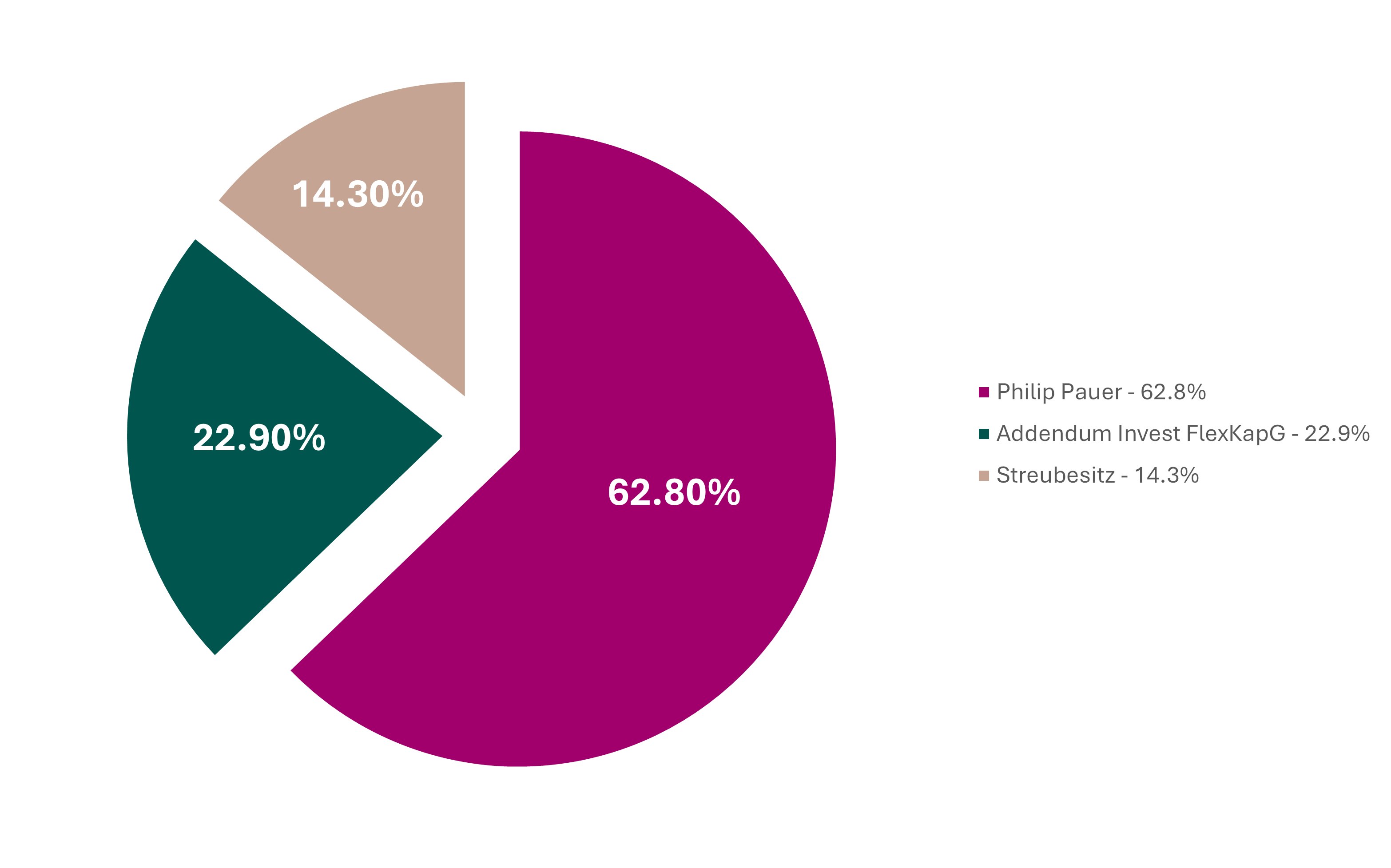
The project owner has a management risk because the Chairman of the Board Philip Pauer is also holding the majority of shares in the project owner. Any absence of the Chairman of the Board could slow down the decision-making process, which could lead to lower income for the project owner from its business activities and have a negative impact on the project owner's net assets, financial position and results of operations. For the bondholders this may mean that interest and redemption payments are not made in whole or in part. There is a risk of management errors on the part of the project owner. Technical, legal or economic misjudgments may occur. It also cannot be ruled out that the shareholder structure may change in the future and that third parties may gain a controlling influence over the project owner. There is a risk that the project owner will not be able to retain or recruit the necessary number of qualified staff to implement the business strategy. Due to the loss of staff with the relevant key qualifications, there is a risk that specialist knowledge will no longer be available. If the key personnel cannot be permanently replaced by qualified staff, this can have a significant negative impact on the economic development of the project owner. This could reduce the amount of interest payments to bondholders and the repayment of the investment amount, or these could be cancelled. In the worst case, there is a total loss of the capital invested. There is a risk that the project owner will get negative media attention. This may lead to significant sales decline and losses for the project owner because there is insufficient demand for the project owner’s products because of the negative media attention. In the worst case, this can also lead to a total loss of the capital invested.