Marketing content

Why invest in battery energy storage project BESS Wehr?

Innovative utility scalebattery at strategic grid location: Large battery systems play a key role in Germany’s energy transition: they stabilise the electricity grid, help smooth out price fluctuations and ensure renewable electricity is available when it is needed.
BESS Wehr adds 11.5 MW of power and 23 MWh of storage at a strong grid location in Baden-Württemberg, on an existing industrial site close to high-capacity connection points.

Suitable financial structure and fixed interest: The project is financed by a mix of senior bank debt, this subordinated bond and shareholder capital. Investors receive 8.00% fixed interest per year over six years, with quarterly interest payments and repayments starting in 2027.
The project earns revenue across several electricity markets, including grid-stability services such as Frequency Containment Reserve (FCR) and Automatic Frequency Restoration Reserve (aFRR), as well as intraday and day-ahead trading, where flexible storage is financially rewarded.

Ready to build with permits and bank support: The land is secured, key permits are in place, the grid connection is agreed, and a fixed price construction contract is signed. A large German bank has issued a binding collateralized senior loan offer after its own technical, legal and financial due diligence.

Top-tier partners at every step: be.storaged, a German specialist in building and maintaining battery systems, will construct and operate the project. Leading global manufacturers such as TrinaStorage and Power Electronics supply the main technology.
A professional energy-trading partner will manage the battery on the relevant electricity markets (contract finalisation in progress).

Strong climate impact and full SDG alignment: BESS Wehr reduces the need for fossil backup power and helps prevent renewable energy from being wasted. The system provides enough storage capacity to supply around 2,500 households for one day, contributing meaningfully to Germany’s net-zero ambitions.
The project supports SDG 7 (Affordable and Clean Energy) and SDG 13 (Climate Action).

Jonas Leve,  Managing Partner, 8Energies

"Our mission is to build flexible battery storage projects that enhance renewable reliability and stabilise the power grid. At 8Energies, we combine deep energy-sector expertise with over 40 years of leadership experience in scaling fast-growing technology companies. This unique mix enables us to operate as a true lean energy company - executing large infrastructure projects with small, high-performing teams and streamlined decision-making. BESS Wehr is a direct result of this approach: a robust, well-structured asset in a strong grid location, supported by experienced partners and a bankable financial framework.

We invite investors to join us in accelerating the clean-energy transition."

Jonas Leve, Managing Partner, 8Energies

Investment information

Days to invest:
21
Investing round ends:
12/01/2026
Type:
Bond
Subordinated:
yes
Invested so far:
€548,750.00
Price per bond:
€250.00
Min offer:
1 Unit
Maximum issue size:
€1,220,000
in 4,880 Units
Interest:
quarterly
Repayment:
quarterly
after 18 Months
ISIN:
DE000A460E13
Broker:
Oneplanetcrowd International B.V
License:
ECSPR

The Bonds are qualified subordinated with regard to any current and future claims resulting from senior debt financing from a German bank.

Overview

Project Information

Project developer: 8Energies GmbH
Address:

Brunnenstraße 13
10119 Berlin
Germany

Industry: Renewable Energy
Website: https://8energies.de/
Social media:


Introduction to the project

The problem

Germany’s energy grid faces a growing challenge: renewable energy sources like wind and solar generate electricity intermittently - only when the sun shines or the wind blows. This leads to frequent imbalances between supply and demand. When too much renewable energy is produced, the grid must curtail it - wasting clean electricity. When too little is available, fossil-fuel backup is still required. These fluctuations threaten both climate goals and grid stability.

The solution

BESS Wehr is a large-scale battery project located in Wehr, Baden-Württemberg, on the grounds of a long-standing industrial paper factory. The site is already zoned for industrial use, making it ideal for a storage project without requiring new land development.

The battery can deliver 11.5 megawatts of power and store 23 megawatt hours of energy, which means it can run for about two hours at full output. It is designed to charge and discharge several times a day to support the electricity system with a target cycling rate of 1.8 per day. The project uses proven technology from TrinaStorage for the batteries and Power Electronics for the power conversion equipment.

Grid access is provided by Naturenergie Netze, and the connection has already been secured. All key permits are in place, and a fixed-price construction contract with the specialist builder (EPC) be.storaged has been signed. The project is therefore fully ready to build. Commissioning is planned for 26 November 2026, with time buffers included.

Once operating, BESS Wehr will also be operated and maintained by be.storaged, whereas the asset management will be carried out by 8Energies. In simple terms, the project earns revenue by stabilising the grid and by arbitraging electricity prices: it buys power when prices are low and sells it when prices are high, participates in ancillary services markets, and provides capacity to the grid. The trading of power and capacity is performed by a top-tier German battery optimizer employing advanced AI for real-time dispatch, with over 1 GW of battery capacity currently under management.

The project benefits the local region by strengthening grid stability and by using existing industrial land instead of new greenfield space. It also supports the wider integration of renewable energy in southern Germany, where flexible storage capacity is increasingly needed due to the high renewable energy penetration in the region.
 

Why Baden-Württemberg and why BESS Wehr?

Baden-Württemberg is one of Germany’s most industrial and energy-intensive regions. As more renewable energy is added to the system, the region increasingly needs flexible storage to keep the grid stable.

BESS Wehr offers ideal conditions for a project like this:

  • A strategically located grid location in an area that benefits from fast-responding storage

  • An existing industrial site, avoiding new land development

  • A secured grid connection from Naturenergie Netze

  • A local industrial joint venture partner that is familiar with the region and supports long-term project success

This makes BESS Wehr a strategically important asset for the regional energy transition.

How BESS Wehr will deliver value:

  • Store surplus renewable electricity so clean energy is not wasted

  • Release power when demand is high or when renewable generation drops

  • Support grid stability and reduce the risk of local overloads

  • Lower CO₂ emissions by reducing the need for fossil backup power

  • Earn revenue on several electricity markets, where flexibility is rewarded

Project status

Icon project status

Status of the project: 

Ready-to-Build

BESS Wehr has reached ready-to-build status. Key permits are secured, the land is under long-term control through the joint venture with the site owner and a land lease contract, and the grid connection from Naturenergie Netze is confirmed. A fixed-price construction contract with the specialist builder be.storaged is already signed. Construction will begin shortly after financing is completed, with commissioning planned for latest by November 2026.

Icon electricity production

Battery performance:

11.5 MW of power and 23 MWh of usable storage capacity

The system can quickly charge and discharge to support the electricity grid in real time. It provides fast grid balancing, helps stabilise frequency, and enables profitable energy trading throughout the day, combining high flexibility, strong performance, and meaningful impact for the regional power system.

Proven expertise & strong partners

8Energies GmbH is the developer behind BESS Wehr. The company specialises in planning, financing and delivering large battery storage projects across Germany. Its goal is to build flexible energy assets that strengthen the electricity system and support the shift toward renewable power.

The founders are experienced entrepreneurs who previously built successful technology companies and now apply that expertise to the energy sector. They are supported by specialists in battery engineering, grid connections, project development and financial structuring. Together, the team covers every stage of a battery project: from finding suitable sites and securing permits to arranging bank financing and managing construction.

For BESS Wehr, 8Energies works with well-established partners for construction, long-term operation, equipment supply and energy trading. This creates a strong and reliable setup that combines local knowledge, technical experience and financial discipline.


Top-tier technology and partners*:

Partner

Role

Highlights

8Energies GmbH

Project developer & asset manager

Develops, finances and oversees large-scale battery projects; experienced entrepreneurial team with strong execution and financing background
TrinaStorage Battery supplier Tier 1 global leader in lithium-ion storage technology, part of Trina Solar; globally recognised, bankable manufacturer; proven large-scale
Power Electronics Inverter & power conversion supplier Global leader in power conversion; >€1.2 billion annual revenue; strong track record in utility-scale storage
be.storaged GmbH EPC & long-term O&M provider German specialist with >300 MWh installed; majority-owned by EWE AG; fixed-price EPC contract and long-term maintenance
Naturenergie Netze Grid operator Regional grid operator; grid connection offer secured and validated through technical due diligence
Leading German flexibility optimizer Route-to-market optimiser One of Germany’s leading storage trading partners; >1 GW flexible assets under management; software-driven optimisation across all merchant markets
Renewable project finance bank Senior lender One of Germany’s largest renewable project finance banks, which provides the senior loan for this project

*Please note that not all contracts have been fully finalized or signed at this stage. The remaining agreements will be executed upon disbursement of the capital.

Impact

The Sustainable Development Goals (SDGs or 'Global Goals') are part of the UN 2030 Agenda for Sustainable Development and constitute the international framework for sustainable development until 2030. These SDGs are intended to put an end to poverty, inequality, and climate change.

BESS Wehr plays a direct and measurable role in Germany’s clean-energy transition. As renewable electricity continues to grow, flexible storage becomes essential to keep the grid stable and to ensure that clean power can be used when it is actually needed.

BESS Wehr directly contributes to:

SDG 7: Affordable and Clean Energy

SDG 7 - Affordable and Clean Energy
BESS Wehr makes renewable electricity more usable, predictable and reliable. Instead of letting surplus solar or wind power go to waste, the battery stores it and releases it exactly when households and businesses need it. This increases the share of clean energy in the grid and helps keep electricity affordable by reducing the need for expensive fossil backup plants. By stabilising the system, the project ensures that a renewable-based power supply can work smoothly even as more wind and solar capacity is added across Germany.

SDG 13: Climate action

SDG 13 - Climate Action
BESS Wehr strengthens the shift away from fossil fuels by stepping in at moments when gas or coal plants would normally be used to stabilise the grid. By providing fast, flexible power from stored renewable energy, the battery reduces the need for these carbon-intensive reserve plants. This leads to lower CO₂ emissions and helps Germany stay on track to meet its climate targets. In addition, by enabling more wind and solar projects to feed their electricity into the grid without curtailment, BESS Wehr increases the overall climate benefit of the renewable system.

Management


Niklas Jansen, Managing Partner, Financing and Structuring

Niklas Jansen

Managing Partner, Financing & Structuring

Co-founder of the learning platform Blinkist, which he successfully scaled and exited. He has invested more than €20 million in young companies and brings extensive experience in complex financing structures, investor relations and project organisation. At 8Energies, he leads the fundraising and financing strategy for BESS Wehr and ensures a robust setup with bank partners and investors.


Jonas Leve,  Managing Partner, Technology and Permitting

Jonas Leve

Managing Partner, Technology & Permitting

Co-founder of 7Mind, Germany’s leading mindfulness app. Jonas guides technical decisions, supervises due diligence processes and leads all permitting steps. His ability to build structured, high-quality processes ensures that projects like BESS Wehr reach ready-to-build status efficiently and reliably.


Manuel Ronnefeldt, Managing Partner, Origination and Sites

Manuel Ronnefeldt

Managing Partner, Origination & Sites

Also a co-founder of 7Mind, Manuel is responsible for sourcing suitable sites, managing land agreements and maintaining strong relationships with landowners and local partners. He led the cooperation with the site owner in Wehr and ensures local alignment and long-term project stability.


Steffen Heinrich, Fractional CTO (Technical Advisor)

Steffen Heinrich

Fractional CTO (Technical Advisor)

Founder of Qinous, one of the pioneers in large-scale battery storage, later acquired by Rolls-Royce Power Systems. Steffen brings deep expertise in battery technology, system design and long-term operation. He ensures that the technical architecture of BESS Wehr meets high industry standards.


Jo Knümann, Project Developer

Jo Knümann

Project Developer

Jo brings hands-on experience from developing more than 500 MW of battery storage projects in Germany. Before joining 8Energies, he worked at ju:niz on large-scale BESS development and previously held roles in real estate and retail project development at IMMOFINANZ and Greyfield Group. With a background in project management, permitting and construction coordination, Jo oversees the full development cycle of BESS Wehr - from technical planning and contractor alignment to grid integration and construction preparation.

Company structure & share distribution

Company Structure

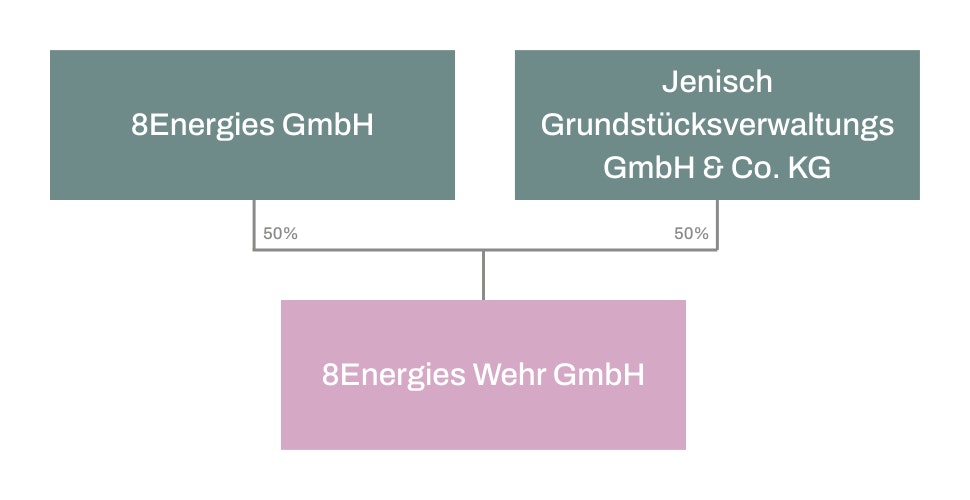
BESS Wehr is built and operated by a dedicated project company, 8Energies Wehr GmbH. This company - the SPV - holds all project rights, receives all revenues from the battery, and is responsible for the bank loan and the repayment of the Invesdor bond.

The Invesdor investors invest directly into this SPV.
This means that investor capital flows straight into the company that owns and operates the battery, ensuring a transparent link between the project’s performance and the repayment of the bond.

Ownership of the project company

The shares in 8Energies Wehr GmbH are held by two partners:

  • 8Energies GmbH – 50%
    Project developer and asset manager responsible for planning, financing, and delivering the project.

  • Jenisch Grundstücksverwaltungs GmbH & Co. KG – 50%
    The local landowner and long-established industrial family behind the paper factory site in Wehr.
    Their involvement ensures long-term alignment, strong local anchoring, and secure access to the industrial land.

Both partners are invested in the project through a combination of equity and shareholder loans.


For investors, this ownership structure provides several benefits:

  • Aligned long-term commitment:
    Both shareholders have invested their own capital and are financially committed to the project’s success. They only receive returns after the Invesdor debt service has been paid in each year.

  • Local stability and secure land access:
    With the landowner holding 50% of the project company and with a strong land lease agreement, the site is secured for the entire lifetime of the battery.

  • Professional development and management:
    8Energies brings the technical, financial and operational expertise needed to deliver and run the project. Investors benefit from a specialised team ensuring professional execution.

  • Clear priority for bondholders:
    Under the project’s financing structure, the bank is paid first, the Invesdor investors are paid second, and only after that do the shareholders receive their repayments.
    This places bondholders in a preferred position relative to the owners.

  • Shared incentives:
    Because shareholders only benefit once the project performs well, their incentives are fully aligned with investor interests: stable operation, predictable revenue and reliable cash flow.

Sources and use of funds

To build and commission BESS Wehr, a total investment of €7.99 million is required. This amount covers all construction, equipment, connection, reserve accounts, insurances and advisory costs needed to bring the project from construction to full operation. As shown in the uses of funds, the interest during construction and the reserve account & liquidity buffer are included in the CAPEX budget. This ensures that interest can be serviced during the construction period and that the reserve account & liquidity buffer is pre-funded upfront, preventing a negative impact on operating cash flows in the beginning of the operational phase.

Investment Budget
Source Use of funds
Equity €1,270,376 Construction & infrastructure costs €5,854,505
Mezzanine loan (Invesdor) €1,220,000 Developement, advisory & transaction costs €1,287,000
Debt €5,500,000 Financial reserves & construction interest €848,871
TOTAL (sources) €7,990,376 TOTAL (uses) €7,990,376

What this means

The majority of the project is financed through a fully collateralized senior loan from a leading German renewable energy financing bank. This means that all the collateral on the assets lies only with the bank, which is why the crowd Investors receive a higher interest rate than the bank. The Invesdor bond provides part of the construction financing and is structured as subordinated debt, ranking below the bank loan but above shareholder loans and equity.

Shareholders (8Energies GmbH and the Jenisch Grundstücksverwaltungs GmbH & Co. KG) contribute €1.27 million of their own capital through shareholder loans and equity, demonstrating their long-term commitment and alignment with investors.

BESS Funding

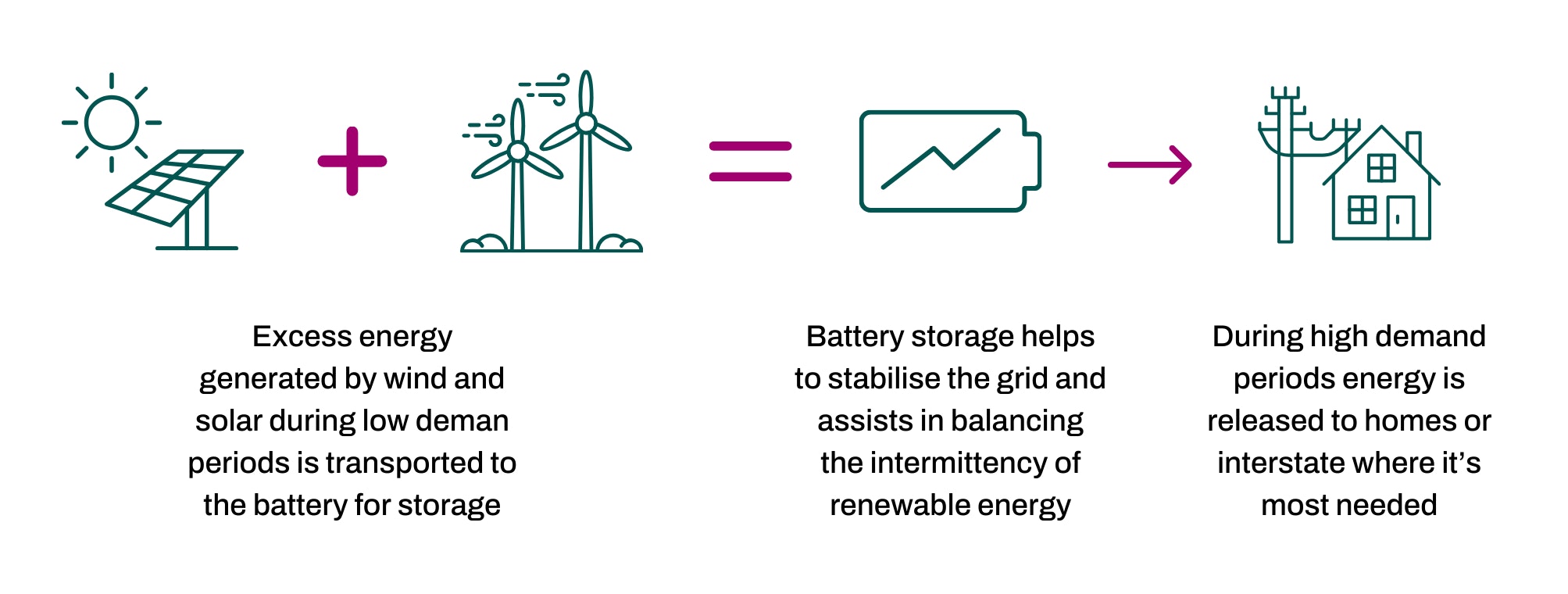
How battery energy storage systems generate revenue?

Battery energy storage systems (BESS) earn money by supporting the electricity grid and making better use of renewable energy. They participate in several markets where flexibility and fast response are valuable.

1. Providing stability to the electricity grid

The grid must always stay in balance. Electricity supply and demand need to match every moment.
If there is too much or too little power in the system, the frequency becomes unstable and, in extreme cases, this can lead to blackouts.

Batteries help prevent this by reacting within seconds:

  • They absorb energy when there is too much electricity

  • They release energy when there is too little

For offering this fast balancing service, batteries are paid by the grid operator. This creates a predictable revenue stream while improving grid reliability.

2. Storing energy when prices are low and selling when prices are high

Electricity prices move throughout the day. When renewable energy production is high, prices often fall. When production drops or demand increases, prices rise.

A battery takes advantage of these price movements:

  • It charges when electricity is cheap, often during periods of strong wind or sunshine

  • It discharges when electricity is more expensive, when the grid needs extra capacity

This “buy low, sell high” approach helps integrate more renewable energy into the system while generating additional revenue.
How energy storage works


Want to learn more about battery storage?

Battery Energy Storage Systems (BESS) are essential to the future of clean energy - but how exactly do they work, and why are they such an attractive investment?

👉 Read our blog article to explore the role of battery storage in the energy transition.

3 advantages for investors 

Icon number 1

Your portfolio will include an investment in a project in the renewable energy sector, something which is usually only available to banks. 

Icon number 2

You are doing something good while profiting from the energy transition.

Icon number 3

Fixed-income with attractive investment returns.

Financial figures & growth

Planned figures

Get an insight into BESS Wehr´s financial figures, such as turnover and earnings development. Learn more about the growth forecast.

Login Sign up

Risks

Investing always involves risks. Below you can find the detailed list of risks related to this investment, as described in the Key Investment Information Sheet (KIIS). Please review this information carefully before making your investment decision.


  • The project owner's plans assume that the project owner stores and sells electricity and provides ancillary services profitably with the battery energy storage plant in Wehr (Baden-Württemberg), Germany, so that the investment of the holders of the bonds (hereinafter "bondholders”) can be fully repaid. The most important risks for the BESS project are the construction risk and the revenue forecast risk. The BESS is not constructed yet, which always poses a risk to the feasibility of the project, and this can have significant effect on the timeline and the actual realisation of it. The project owner’s plans assume that the risks associated with the construction (e.g. delay in equipment delivery, insufficient quality control, unfavourable weather conditions) can be mitigated by contractual agreements with experienced parties (be.storaged GmbH [Oldenburg Local Court, HRB 204257] as engineering, procurement and construction party [EPC] and Operations and Maintenance party [O&M], Baloise Sachversicherung AG Deutschland [Bad Homburg Local Court, HRB HRB 9357] as insurer regarding the construction and Allianz Versicherungs-AG [Munich Local Court, HRB 75727] as insurer regarding the operation of the BESS). Whereas the contractual agreement with be.storaged GmbH as the EPC and O&M party is already signed, all other contractual agreements are currently not finally negotiated but are in the final stage. In addition, the project owner’s plans assume that the present operational risks (construction costs overrun, site/geotechnical risks, regulatory/permitting delays with view of water protection, legal action by environmental groups, commissioning risk especially regarding battery degradation and market volatility) will be mitigated by contractual agreements with experienced parties (be.storaged GmbH as O&M) and professional route to market providers (optimizers) that will ensure and partially guarantee a certain availability of the BESS. The optimizer that will select the best market for maximising the revenue on each day and will take over the commercialisation will be enspired GmbH, Austria (registration number: 528204X). The optimizer considered currently is established in the BESS market. Draft offer from this optimizer with enough flexibility to switch to another optimizer (cancellation period of 6 months after expiry of the minimum contract period) if necessary is already in place. The assumptions made by the project owner could prove to be inaccurate. This can mean for the bondholders that interest payments and or the repayment are cancelled in whole or in part.
  • The increased penetration of large-scale BESS with view of provision of primary control energy (balancing energy that's activated rapidly, within 30 seconds, to quickly adjust for frequency deviations in the grid and maintain the grid's frequency within a narrow range (49.99 Hz to 50.01 Hz)) can have large negative impacts on revenues. Furthermore, potential regulatory adjustments in the Frequency Containment Reserve (FCR) market that include the re-introduction of 30 minutes as minimum activation period, can marginally impact the revenues of the project owner negatively. In addition, in the event of changes in the legal and/or regulatory requirements the project owner might not be able to comply with the new requirements on time, which can lead to measures by authorities (fines, closure of businesses, etc.). This would lead to lower income for the project owner from its business activities and have a negative impact on the project owner's net assets, financial position and results of operations. For the bondholders this may mean that interest and redemption payments are not made in whole or in part.
  • Incorrect forecasts by the grid operator as part of redispatch measures can have a number of negative consequences for operators of BESS and thus for 8EW. If the BESS is called up or shut down at an unfavorable moment due to an incorrect forecast of the grid operator, this can result in 8EW having to buy or sell electricity at suboptimal prices (revenue loss). Also, as BESS is often used for arbitrage, i.e. charging when prices are low and discharging when prices are high, if the BESS is prevented from doing so due to incorrect redispatch instructions, economic losses would be incurred. In addition, suboptimal charging and discharging cycles or low discharge level or overcharging due to incorrect instructions, can affect the service life of the battery cells or result in long-term technical damage. Furthermore, forecast errors by the grid operator, which lead to restrictions on participation in the electricity market (e.g. intraday market) by 8EW, may lead to 8EW not being able to meet its obligations due to redispatch interventions and as a result losing market opportunities. Also, as incorrect redispatch forecasts make operational planning more difficult and lead to additional effort in managing the use of the BESS and additional administrative effort (e.g. for billing, monitoring and communication with the grid operator) due to frequent or incorrect redispatch integration. Last but not least, the redispatch compensation for BESS operators in accordance with Section 13a EnWG and the Redispatch 2.0 mechanism is based on standard values or forecast values that do not always reflect the actual economic losses. If forecasting errors lead to frequent and costly interventions, there is a risk of disputes over the amount or appropriateness of compensation. If one or more of the aforementioned scenarios occur, this would lead to lower income for 8EW from its business activities and thus for the project owner and have a negative impact on the project owner's net assets, financial position and results of operations. For the bondholders this may mean that interest and redemption payments are not made in whole or in part.
  • The project owner may be unable to compete effectively with existing and potential new competitors or to respond to changes in the competitive environment, which may adversely affect its business performance. In particular, risks to the project owner's business could arise in the case of a potential introduction of new subsidization regimes for BESS, which would lead to higher competition and lower revenues. If these competitors expand their business more successfully than the project owner,this could worsen the project owner's business situation.
  • In view of the technical due diligence (DD) carried out by Clean Horizon Consulting, Paris, France with no major issues identified, the fact that established suppliers will provide the components for the projects, the draft of the asset management agreement with 8E in alignment with industry standards and the current signed EPC agreement and the signed O&M agreement with be.storaged GmbH, in which a performance guarantee (availability guarantee of 97 %) and a warranty for the components (guarantee on main components of 15 years), an energy capacity guarantee and performance guarantees are provided, the technical risk is considered to be manageable. The identified risks in the technical DD are the following: As the geotechnical study is slightly outdated the recommendation in the technical due diligence is to do a new study that can factor in the equipment layout for the planned drillings and investigations to confirm soil adequacy. In addition, there are minor deviations in noise levels making an additional noise study, especially for the night necessary.
    Furthermore, the BESS project is slightly undersized in terms of installed DC capacity, which is already addressed in the EPC contract (included liquidated damages clause to recover any lost revenue up to a certain maximum amount). Missing warranties and specifications could still pose a certain risk. This can mean for the bondholders that interest payments and or the repayment are cancelled in whole or in part.
  • The main legal risks include the status of contracts with the Asset management party, the optimizer and the insurance (mostly draft versions with partially missing specifications). As the building permit is not unappealable by environmental agencies, any appeals from environmental organizations can delay or even stop the project. Changes in the regulatory environment (e.g. change in grid fees, taxes on BESS) and an increase of the grid connection price (increase by up to 15% possible) could have a negative impact on the project owner’s business. For the bondholders this may mean that interest and redemption payments are not made in whole or in part.
  • The managing partners, who have a track record in fundraising, scaling and partially in renewable energy and BESS development, and the company structure give confidence that the management risks are limited. Nevertheless, the founding team of 8E that leads the BESS project cannot demonstrate a track record for installed BESS projects in Germany.
In accordance with Article 2(1)(a) of Regulation (EC) No 1893/2006 of the European Parliament and of the Council 5(Regulation), the project owner's business is best described by the classification of Section D in Annex 1 of the Regulation. The BESS market is nascent and very dynamic, so reliable revenue-side empirical values or marketing patterns are hardly established. Possible regulatory measures and interventions, technical developments, falling investment costs, financial uncertainty, but also growing competition in this space can significantly restrict the market. Moreover, climate changes in the region could significantly restrict the aforementioned market and make the business activities of the project owner effectively impossible.

The bondholders bear the full risk of the project owner’s insolvency, i.e., the risk that the project owner is temporarily or permanently unable to meet its payment obligations to the bondholders and or third parties on time. Especially in the context of insolvency proceedings, the bondholders could suffer a total loss. The following specific occurrences could lead to this:

  • (a) (serious) change in the macroeconomic situation,
  • (b) mismanagement,
  • (c) lack of experience,
  • (d) fraud,
  • (e) financing that is not in line with the business purpose,
  • (f) unsuccessful introduction of the project owner’s service,
  • (g) lack of cash flow.

There is a risk that, as a result of all of the risks mentioned in Part C, return may be lower than expected, delayed or no principal or interest payments may flow from the project. Furthermore, the value of the return could be reduced by inflation. If the inflation rate is higher than the interest rate on bonds, the return on bonds will be negative. The bonds will be issued in Euro and the interest payable on the bonds will also be calculated and paid in Euro. For this reason, investors who have earned income or assets in a currency other than Euro or who do not require the income from the investment in the bonds to be denominated in Euro are exposed to a currency risk because they are exposed to exchange rate fluctuations which may reduce the yield of the bonds. Furthermore, in the event of a necessary sale of the bonds for the bondholder, additional costs (transaction costs such as consultancy fees) may arise which reduce the return.
The individual return of the respective investor may vary in individual cases and depends on the individual tax situation in each case, which may lead to a reduction in the return.

A temporary or permanent failure of the crowdfunding platform or the payment service provider specified in Part D, letter d) may lead to the temporary cancellation of interest and repayments. Since the crowdfunding service provider at no time acquires possession or ownership of the subscription amounts of the investors or of the interest and repayment amounts and since the payment service provider merely acts as trustee for the project owner as trustor, a loss of the invested capital based solely on a failure of the platform or the payment service provider is unlikely.
The bonds have a fixed contractual term. The transfer of the bonds is also technically restricted in that a transfer is only possible to digital safe deposit boxes registered with the project owner or the registrar. The "Registrar" that maintains the e-securities register is Smart Registry GmbH, registered in the commercial register of the Charlottenburg District Court in Berlin under registration number HRB 234468 B. "Digital safe deposit box" is an IT application used to store public keys and private keys and to interact with technology, the functionalities of which make it possible to hold and transfer e-securities. The securities are currently not tradable on a stock exchange, nor is there a liquid secondary market. Even if the securities are included in trading on one or more trading platforms for securities, it is uncertain whether trading of the bonds will actually develop. The risk that the bondholder is unable to find a buyer for the bonds or can only sell them for a price that he considers to be too low is borne solely by the bondholder. The bonds may also turn out to be completely illiquid. A sale of the bonds by the bondholder may therefore only be possible to a limited extent. There is a risk that the bonds cannot be sold or can only be sold at a financial loss. For bondholders with short-term capital requirements, this means that they may not be able to dispose of the capital invested at the desired time, especially as bondholders do not have an ordinary right of termination during the term.

The following securities-related risks also exist:

  • i) No rights of influence and participation
    The bonds themselves only establish claims under the law of obligations against the project owner and do not grant any participation, involvement and/or voting rights in or at the shareholders' meeting of the project owner. Shareholder resolutions may be passed at the shareholders' meeting of the project owner which may have a detrimental effect on the individual bondholders. The bondholders have no opportunity to influence the business activities of the project owner. This also applies to the utilisation of the capital raised through the issue of the bonds. In particular, bondholders do not have the opportunity to terminate loss-making business activities of the project owner before the contributed capital has been utilised. For bondholders, this can lead to the total loss of the capital invested.
  • ii) Deterioration of the conditions by majority resolution
    According to the Terms of Issue, these can also be adjusted during the term of the bonds if the necessary votes of the bondholders have been obtained by majority resolution in accordance with the Terms of Issue. In this respect, the individual bondholder bears the risk that changes to the Terms of Issue may be made against his will on the basis of the majority resolution of the bondholders, which may be to his disadvantage (e.g. lower interest rate, extended term or waivers).
  • iii) Structural risk and risk of qualified subordination with an indefinite pre-insolvency enforcement bar with regard to claims of the senior creditor
    The obligations of the project owner to the investors or bondholders, including interest and principal payments, are qualified subordinated to any current or future debt financing from the senior creditor. As stated under Part A (f) of the KIIS in any case there will be a senior loan that is to be granted to the project owner for a loan amount of € 5.5 million by the senior creditor the latest before the day of the disbursement of the funds collected within the scope of this crowdfunding offer. The bond issue planned as part of the crowdfunding is qualified subordinated to this loan to be granted by the senior creditor. The project owner's obligations under the bonds are not secured by any form of security or collateral, in whatever form. But the senior creditor will as industry standard have full collateral and securities on the BESS project and its assets. This means that the project owner may have to suspend its interest and principal payments to the bondholders if it cannot make payments in connection with the above-mentioned debt financing from a bank, e.g. because revenues are insufficient. This can mean for the bondholders that interest payments and or the repayment are cancelled in whole or in part. In the case of foreclosure on securities held by the senior creditor and of sale of the assets of the BESS project, the project owner would not be able to meet its payment obligations on time or at all, which might lead to a loss or partial loss of the capital invested and/or the return for the bondholders. In addition, all claims of the bondholders arising from the bonds, including repayment and interest claims (hereinafter also referred to as “subordinated claims”), are subject to a qualified subordination (including pre-insolvency enforcement bar). The subordinated claims of the bondholders can only be settled from future annual surpluses, any liquidation surplus or from other free assets that remain after the claims of the senior creditor of the project owner have been fulfilled. The enforcement of a bondholder's claim to payments is therefore dependent on the economic situation of the project owner and, in particular, on its liquidity situation. For the bondholders, there is a risk that, in the event of such a reservation of payment, they will not be able to demand payment from the project owner on the actual payment date due to the lack of an enforceable claim. This also applies in the event that the satisfaction of the individual qualified subordinated claims on maturity would not in itself give rise to insolvency, but the payment to all qualified subordinated bondholders would give rise to insolvency. The agreed pre-insolvency enforcement bar can therefore lead to a permanent non-fulfilment of the bondholders' claims arising from the bonds and thus to the total loss of the capital invested. As a result, bondholders bear an entrepreneurial risk of loss without at the same time being granted information and participation rights that would enable them to influence loss-making business activities. Bondholders bear an entrepreneurial business risk that goes beyond the general insolvency risk that exists anyway. In the event of insolvency or bankruptcy under German law of the project owner, any obligations of the project owner to any senior creditor would take priority over payment of the payment obligations under the bonds. This means that there is a risk that, in the event of insolvency, lower or no quotas will remain to pay all or even parts of the outstanding claims under the bonds. Until the disbursement of the proceeds of the bond issuance (payout), the interest rate of the senior bank financing and the amount of the Debt Service Reserve Account (DSRA) may change as part of the final loan agreement negotiations with the senior creditor, over which the bondholders have no influence. Changes to these parameters may adversely affect the liquidity of the project owner and, consequently, its ability to make interest and principal payments to the bondholders.
  • iv) Risk of insolvency of key contract parties
    In the event of insolvency of key suppliers for batteries, inverter & MV systems, there would be a risk that the project owner would have limited options to quickly procure batteries, inverter & MV systems from alternative suppliers. In the event of insolvency of key contract parties (e.g. O&M, optimizer), there would be a risk that the project owner would not be able to quickly find contractual partners with comparable terms and conditions. This could lead to temporary reductions in the project owner’s income and make it more difficult for the project owner to properly service the claims of investors or bondholders.
  • v) Technology and database risks
    The technology and all related technological components and regulated services (e.g. digital custody, e-securities register management) are still at an early stage of technical development. There is a risk for bondholders that this technology may be subject to technical difficulties or that its functionality may be impaired by external influences. A partial or complete collapse of the electronic decentralised database (hereinafter ‘e-database’) relevant to the e-securities could make it temporarily and permanently impossible for bondholders to access their e-securities. There is a risk of attacks against the network or the e-database used. Various types of attacks are conceivable. These attacks could render the network or e-database unusable, making it impossible for bondholders to transfer the e-securities. If the network or e-database becomes completely unusable, there is a risk that bondholders will no longer have access to their digital safe deposit boxes. In the worst case scenario, this could lead to the irretrievable loss of the e-securities. The project owner offers the bondholders a technical solution via an authorised e-securities custodian that serves to hold, store and dispose of e-securities. There is a risk that this solution is flawed and/or particularly vulnerable to possible hacker attacks. As a result, bondholders may be temporarily or permanently unable to access their e-securities, which in the worst case could lead to the irretrievable loss of the e-securities. Neither the e-securities custodian nor the project owner will take over the administration in the sense of the ongoing exercise of the rights and obligations arising from the e-securities.
    The risks listed above are not the only risk factors affecting the operations of the project owner. Also, other risks and uncertainty factors that the project owner currently does not identify or considers presently irrelevant may have an integral effect on the business operations, business results and financial standing of the project owner.

Documents

Updates

There are currently no updates available.

This section will be regularly updated with new, project-relevant information as the financing progresses. To be informed about new updates in a timely manner, subscribe to our newsletter.

Zertifizierte B- Corporation

Certified B Corporation for sustainable finance

ECSP lizensiert

Licensed under the EU ECSP regulation