Marketing content

Why invest in Der Solarteur

Attractive terms in a growing market
8% fixed interest over three years, offering a compelling return profile in a structurally growing market environment driven by the energy transition in the building sector.

High demand and a stable long-term market environment
Housing companies and industrial firms in particular must rapidly upgrade their existing buildings to improve energy efficiency and solve their ESG requirements. Demand exceeds the available installation capacity.

A proven B2B partner for large building portfolios
Der Solarteur is among the providers that reliably deliver serial installations for existing buildings - backed by a strong order pipeline, driven in particular by a framework agreement with one of Europe’s largest housing groups and partnerships with municipal utilities.

Operational strength through digital processes
IT-based workflows for project execution and billing, clear quality standards, and well-coordinated teams enable the efficient delivery of large project volumes - creating a structural advantage over traditional installation companies.

Stable supply chains and purchasing advantages
Direct access to Tier-1 materials ensures availability, quality, and predictable project costs - an essential factor for growth and margins.

Thomas Sontowski and Salvatore Prestipino, Managing Directors of Der Solarteur

“Demand for photovoltaic and heat pump solutions for existing buildings continues to grow. With digital processes, well-coordinated teams, and an actively managed value chain - from procurement of materials and planning through to installation and commissioning - combined with stable supply chains, we are able to deliver large project volumes efficiently and reliably. To meet our customers’ increasing demand, we require additional funding to pre-finance orders, including material purchases and the expansion of our installation capacity.

Support us in further accelerating the energy-efficient modernisation of buildings and in strengthening our sustainable growth.” 

Salvatore Prestipino & Thomas Sontowski, Managing Directors of Der Solarteur

Investment information

Investing end:
09/01/2026
Type:
Bond
Subordinated:
no
Invested so far:
€1,100,000.00
Price per bond:
€250.00
Min offer:
1 Unit
Interest:
quarterly
Repayment:
quarterly
after 3 Months
ISIN:
DE000A460E05
Broker:
Oneplanetcrowd International B.V
License:
ECSPR

Overview

Company profile

Der Solarteur is a fast-growing, primarily B2B provider of planning and installation services for photovoltaic systems, complemented by heat pumps and battery storage - delivering integrated energy solutions with a clear focus on the residential housing sector as well as commercial and industrial clients. Since its founding in 2021, the company has completed more than 2,800 installations, built a team of around 50 employees, and established a strong presence primarily in North Rhine–Westphalia.

Market demand is substantial: large housing companies and municipal utilities must rapidly decarbonise their existing building portfolios, yet struggle to find partners capable of delivering high volumes, quality-assured processes across the entire value chain, and reliable supply capacity at the same time. This market challenge creates a significant structural bottleneck - and, in turn, a clear business opportunity for professional providers such as Der Solarteur.

Der Solarteur addresses this situation with a modern approach: fully digitalised and scalable processes, robust access to Tier-1 components, and well-coordinated installation teams. This combination enables the efficient execution of large project volumes - representing a decisive advantage over the highly fragmented market of small and mid-sized craft businesses.

This operational strength has secured the company access to one of Europe’s leading housing groups through a framework agreement. With an order pipeline of around €17 million and ongoing negotiations with additional major housing companies, Der Solarteur is strategically well positioned to continue scaling in a rapidly growing future market - offering investors access to a professionally managed company with strong growth potential.

Company info

Company name: Der Solarteur GmbH
Managing directors: Thomas Sontowski, Salvatore Prestipino
Business ID number: HRB 33355, Dortmund Local Court
Founding year: 2021
Address: Am Kai 22
44263 Dortmund
Germany
Industry: Renewable Energy / Photovoltaics / Building Technology
Number of employees: 50
Locations: Dortmund (headquarters), Hamburg
Website: www.der-solarteur.com
Social media:


Products and services

Der Solarteur offers an integrated portfolio of services covering photovoltaic systems, heat pumps, and battery storage - delivering modern energy solutions fully from a single source and clearly tailored to the needs of housing companies in particular, as well as industrial clients. The combination of technical expertise, digitalised processes, and high execution capacity enables the reliable delivery of even large project volumes.
 

Rooftop photovoltaic systems for the residential housing sector, commercial and industrial clients

Der Solarteur plans and delivers rooftop PV systems specifically designed to meet the requirements of large building portfolios. This includes:

  • technically optimised system design, including structural assessments and yield calculations
  • professional installation by in-house teams and specialised partners
  • complete commissioning and documentation
  • high process reliability through standardised workflows
  • no maintenance or other sales services are offered

Especially in the existing-building segment - where complexity is significantly higher than in new construction - Der Solarteur is among the few providers capable of reliably executing serial installations at scale.
 

Photovoltaic systems

Heat pumps and complementary energy solutions

In addition to PV systems, Der Solarteur also installs heat pump systems designed for housing companies and commercial properties. Services include:

  • site-specific system sizing and technical planning
  • integration into existing building structures
  • installation, hydraulics, control systems, and commissioning

The combination of PV and heat pumps increases the energy autonomy of buildings and significantly enhances CO₂ savings - an important factor in achieving the decarbonisation targets of large property owners.
 

Heating pump

End-to-end project delivery with a digital process backbone

Der Solarteur manages the entire project lifecycle - from material procurement and construction through to billing. The key differentiator, however, is its digital, Salesforce-based process infrastructure:

  • end-to-end site and photo documentation
  • digital checklists for every project step
  • centrally managed quality standards
  • real-time, transparent progress and performance tracking
  • faster invoicing enabled by verifiable milestone completion

This digital structure makes large project volumes not only economically viable but also fully manageable - representing a significant advantage over the traditional, craft-driven solar installation market.

Project execution

Business model

Employee working among photovoltaic modules

Photovoltaic system in a natural setting

Der Solarteur’s business model is built around the efficient delivery of energy projects, particularly for large B2B clients - most notably housing companies and commercial enterprises. Value creation stems not only from installation itself, but above all from a structured process organisation that makes projects predictable, scalable, and economically efficient.

At its core, Der Solarteur combines three key elements:

  1. standardised technical planning,
  2. centrally managed material and resource logistics, and
  3. digitally driven installation and billing processes.

This integrated structure enables the parallel execution of multiple projects and ensures reliable margins on every contract.

Revenue is generated on a project basis through clearly calculated installation services, material supply, and defined milestones that can be invoiced early thanks to digital documentation. Especially with large clients that call off high volumes, this structure results in stable order flows and highly predictable revenues. The economic advantage lies less in individual large projects and more in the continuous repetition of standardised processes that generate scale effects.

A central enabler of scalability is the company’s proprietary IT architecture. It reduces dependency on individual specialists, establishes uniform quality standards, and allows for the efficient coordination of teams and subcontractors. As a result, Der Solarteur can flexibly expand capacity and economically support growth in the residential and commercial customer segments.

Through access to European central warehouses of leading component manufacturers, Der Solarteur secures stable supply chains and competitive purchasing conditions. Combined with increasing project volumes from existing clients, this creates a business model designed for operational efficiency, repeatability, and predictable growth.

Market

Photovoltaic modules

The market for photovoltaic and heat pump solutions in the residential housing sector and in commercial applications continues to grow. Large property owners are under significant pressure to decarbonise their existing building portfolios, yet require partners capable of delivering large project volumes in a reliable and standardised manner. This is precisely where a structural bottleneck is emerging in the market - creating a clear opportunity for professional providers.

Competition remains highly fragmented: many installation companies are craft-oriented, regionally limited, and not operationally equipped for serial installations in existing buildings. The requirements of large B2B clients—predictable capacity, fast acceptance processes, consistent quality, and comprehensive documentation - can be met by only a small number of market participants.

Der Solarteur is one of these few providers. The company combines digital, IT-based process control with standardised workflows, stable Tier-1 supply chains, and well-coordinated installation teams. This enables the efficient, transparent, and cost-effective execution of projects at scale - a decisive competitive advantage.

Its positioning in the residential housing sector is particularly strong: Der Solarteur carries out serial retrofit installations for one of Europe’s largest housing groups and is in discussions with other major market players. These references, combined with digital scalability and process reliability, give the company a strong starting position in a market that is increasingly consolidating around a limited number of trusted partners.

Impact

The Sustainable Development Goals (SDGs), also known as the Global Goals, are part of the United Nations’ 2030 Agenda for Sustainable Development and form the international framework for sustainable development through 2030. The SDGs aim to end poverty, reduce inequality, and combat climate change.

Der Solarteur makes a direct contribution to the energy transition of residential and commercial buildings. Through photovoltaic systems, heat pumps, and modern energy concepts, fossil fuels are replaced, CO₂ emissions are permanently reduced, and buildings are made more energy-efficient and resilient over the long term.

The company’s activities directly support two key United Nations sustainability goals:

SDG 7

SDG 7 - Affordable and Clean Energy
Der Solarteur makes renewable energy directly accessible to large building portfolios. By installing photovoltaic systems, battery storage, and heat pumps, the company increases the share of clean energy in the building sector while simultaneously reducing energy costs for tenants and commercial users. Especially in existing buildings - where energy inefficiencies are often significant - this creates a direct and measurable contribution to a sustainable energy supply.

SDG 9

SDG 9 - Industry, Innovation and Infrastructure
Through its digital, IT-based process architecture, Der Solarteur creates efficient and scalable workflows that accelerate the implementation of sustainable infrastructure projects. Standardised documentation, quality control, and performance verification make it easier for large clients to modernise their portfolios in an economically viable way and contribute to a future-ready, more resilient energy infrastructure.

Especially in the residential housing sector - a segment with significant CO₂ reduction potential - Der Solarteur’s work has a substantial impact. Every retrofitted rooftop permanently lowers emissions, improves the energy efficiency of entire neighbourhoods, and helps property owners meet regulatory ESG requirements. In addition, the installed system solutions reduce tenants’ ancillary energy costs, thereby increasing the attractiveness of existing properties.

Management


Salvatore Prestipino, Managing Director (Commercial)

Salvatore Prestipino

Managing Director (Commercial)

Salvatore Prestipino is responsible for commercial management, sales, and strategic development at Der Solarteur. He brings more than 20 years of experience in senior positions within the energy sector, including serving as Managing Director of a municipal grid operator. His focus areas include building efficient sales and customer management structures, streamlining customer processes, overseeing financial planning, and developing scalable organisational frameworks. Under his leadership, Der Solarteur has become a trusted partner for housing companies and municipal energy providers.


Thomas Sontowski, Managing Director (Technical)

Thomas Sontowski

Managing Director (Technical)

Thomas Sontowski is responsible for the technical division and operational project delivery. He has many years of experience in the planning and management of complex photovoltaic and building-technology installations and developed the standardised, digitalised processes that now form the foundation of the company’s high scalability. Through his technical expertise and close collaboration with the installation and planning teams, he ensures the quality and efficiency of all projects.

Company structure

Company structure

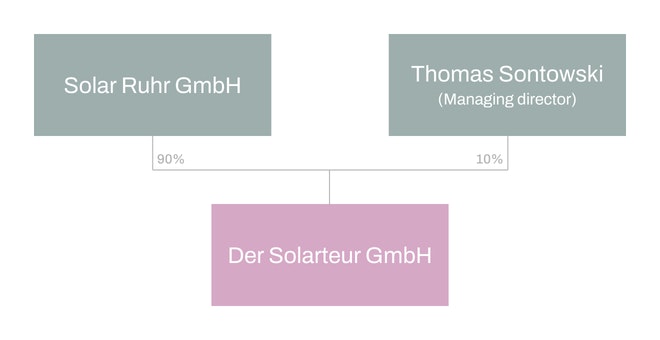
Investors invest directly in Der Solarteur GmbH, the operating company that plans and installs photovoltaic, battery storage, and heat pump projects.

Der Solarteur GmbH is 90% owned by Solar Ruhr GmbH, with the remaining 10% held by Managing Director Thomas Sontowski.

Through its partner companies PVI GmbH (a wholesaler of solar components, battery storage systems, and heat pumps) and On Energy GmbH (a project developer of large-scale ground-mounted solar plants), Solar Ruhr GmbH covers a significant portion of the value chain for sustainable energy solutions.


Info Icon

What does this mean for investors?

Stable supply chains & purchasing advantages
Through its connection to PVI GmbH, Der Solarteur benefits from long-standing relationships with key industry suppliers, improved purchasing conditions, and reliable material availability.

Technical & strategic expertise within the group
Solar Ruhr and On Energy contribute experience in energy projects, project development, and commercial management - providing a strong foundation for professional growth.

Use of funds

Der Solarteur is in a dynamic growth phase: The expansion in the residential housing and industrial sectors is leading to significantly higher project volumes, while material lead times, subcontractor services, and deferred payment terms are increasing the working capital requirements. Financing through Invesdor enables the company to expand its installation capacities, secure material availability, and efficiently process its extensive order pipeline.

The financing amount for this round is up to €1,000,000. Depending on the total amount raised, the following funding scenarios are possible:


Icon 1

Minimum scenario

(Minimum funding threshold of €400,000 for the financing round)

In this scenario, Der Solarteur can continue its ongoing growth in a stable manner and reliably deliver on existing projects - particularly in the residential housing sector and with municipal utilities. The focus is on securing supply reliability and executing installation volumes that have already been contractually agreed.

Use of funds:

  • 50% - Pre-financing of materials
    Securing the supply of solar modules, inverters, mounting systems, and heat pumps for ongoing framework agreements.
  • 25% - Expansion of installation and subcontractor capacity
    Deployment of additional installation teams, training, and flexible capacity expansion to meet rising demand.
  • 15% - Working capital for project-related operations
    Coverage of personnel, logistics, and site costs until project acceptance.
  • 10% - Process and system optimisation
    Further development of digital installation, documentation, and billing processes.

This scenario ensures operational continuity and enables Der Solarteur to deliver all ongoing projects on schedule.

Icon 2

Maximum scenario

(Maximum financing amount of up to €1,000,000 in the financing round)

In this scenario, Der Solarteur can fully implement its growth plans and significantly increase installation capacity. This enables the company to expand cooperation with large housing companies, launch new projects more quickly, and tap into additional market potential.
 

Use of funds:

  • 55% - Expansion of material procurement and storage capacity
    Larger order volumes, improved purchasing conditions, and short-term availability for serial installations in existing buildings.
  • 25% - Scaling of project execution
    Build-up of additional installation capacity, closer collaboration with subcontractors, and parallel delivery of larger project volumes.
  • 10% - Expansion of digital infrastructure
    Optimisation of the Salesforce-based process chain, quality control, and documentation to support higher volumes.
  • 10% - Strategic preparation for new large-scale customer projects
    Onboarding of new residential housing clients, technical pre-planning, and process adjustments for higher call-off volumes.

This scenario enables the company to fully execute its growth strategy, significantly expand installation capacity, and activate its project pipeline for the coming years at an even faster pace.

Financial figures

Actual and projected figures

Gain insight into the company’s financial performance, including revenue and earnings development. Learn more about the growth outlook.

Login Sign up


End of marketing content

Security & risks

Security

Solar Ruhr GmbH, Am Kai 22, 44263 Dortmund, Germany, registered in the commercial register of the Iserlohn Local Court under commercial register number: HRB 8819, has undertaken, within the framework of a guarantee, to be liable to the bondholders for the non-payment of interest and/or repayments from the bonds in the amount of 50 % of the actual subscription amounts collected within the scope of the crowdfunding project, thereby up to a maximum of € 500,000.

To secure the payment obligations arising from the bonds (interest payments and/or repayments), the project owner undertakes in favour of the bondholders, to the extent legally possible, by way of assignment for security purposes with collection authorisation for the project owner, to assign all current and future payment claims and other rights arising from existing and future contractual relationships of the project owner with third parties, regardless of their nature, to the bondholders, whereby the trustee is entitled to revoke the collection authorisation on behalf of the bondholders as soon as an event of default pursuant to § 4 number 3 of the Issue Terms arises;
The value of collaterals/guarantees can fluctuate, especially in the event of default, potentially resulting in diminished return.

Risks

Investing in growth companies always involves risks. Below you can find the detailed list of risks related to this investment, as described in the Key Investment Information Sheet (KIIS). Please review this information carefully before making your investment decision.


  • i) Project dependencies such as financing, legal aspects, licensing, copyrights:
    The crowdfunding offer may raise less capital than planned. This may result in the project owner not being able to successfully implement its planned project due to a lack of funds. This would lead to lower income for the project owner from its business activities and have a negative impact on its net assets, financial position and results of operations. This may have the consequence that the claims from the bonds cannot be fulfilled or cannot be fulfilled in the planned amount. In the worst case, there is a total loss of the capital invested.
    Violations of legal or regulatory requirements can lead to measures by authorities (fines, closure of businesses, etc.). This would lead to lower income for the project owner from its business activities and have a negative impact on the project owner's net assets, financial position and results of operations. For the holders of the bonds (hereinafter "bondholders"), this may mean that interest and redemption payments are not made in whole or in part.
    The access to personnel (master electrician, master roofer and specialist craftsmen) is strategically important for the achievement of the planned installation capacities and thus for the planned growth of the project owner. The growth is to be managed with the involvement of subcontractors. The project owner is already working with four larger roofing companies, where scalable trained teams can be called upon. In the event of insolvency of the aforementioned roofing companies there would be a risk that the project owner would not be able to quickly find contractual partners with comparable terms and conditions. This could lead to temporary reductions in the project owner’s income and make it more difficult for the project owner to properly service the claims of investors or bondholders.
  • ii) Occurrence of adverse scenarios with negative impacts:
    The project owner's plans assume that the order pipeline will remain strong thanks to the framework agreement with one of Europe's largest housing groups and partnerships with municipal utilities. The framework agreement with the aforementioned housing group, which is limited in time until the end of 2026, will need to be prolonged. Even though it is more likely than unlikely that the contract will be extended, as - the current contract is already the third extension – the housing group has to date commissioned only a few companies after thorough due diligence and the screening of new companies is time-consuming and costly. The assumptions made by the project owner in the planning regarding the prolongation of the aforementioned framework agreement could prove to be incorrect. For the bondholders, this could mean that interest and redemption payments are not made in whole or in part.
    Scenarios such as a pandemic and/or political tensions could lead to supply chain problems, meaning that the project owner may not be able to procure the components required for the installation of solar systems and therefore not be able to produce products in the required quantity and/or quality and sell them at a profit. Especially, there are geo/trade policy risks regarding China, which would certainly be difficult to manage a longer period of time. For the bondholders, this could mean that interest and redemption payments are not made in whole or in part.
  • iii) (technological) development of competitors or competing products:
    The project owner may be unable to compete effectively with existing and potential new competitors or to respond to changes in the competitive environment, which may adversely affect its business performance. In particular, risks to the project owner's business could arise if these competitors expand their business more successfully than the project owner, which could worsen the project owner's business situation.
  • iv) risks associated with the project owner:
    Although the project owner is not an early-stage company, it is nevertheless in a growth phase and the financing of such a company is associated with specific risks. If the already established business idea is no longer accepted by the market in the future or if the planned business development cannot be implemented as hoped, there is a risk of the project owner becoming insolvent. The company's success depends on various factors, such as financing, the team, specialists and consultants, the market environment, technological developments, property rights, legal framework conditions, competitors and other factors. For the bondholders investing in a company in a growth phase, this increases the risk that they will lose their invested capital.
    There is a risk of management errors on the part of the project owner. Technical, legal or economic misjudgments may occur. It also cannot be ruled out that the shareholder structure may change in the future and that third parties may gain a controlling influence over the project owner. There is a risk that the project owner will not be able to retain or recruit the necessary number of qualified staff to implement the business strategy. Due to the loss of staff with the relevant key qualifications, there is a risk that specialist knowledge will no longer be available. If the key personnel cannot be permanently replaced by qualified staff, this can have a significant negative impact on the economic development of the project owner. This could reduce the amount of interest payments to bondholders and the repayment of the investment amount, or these could be cancelled. In the worst case, there is a total loss of the capital invested.
    There is a risk that the project owner will get negative media attention. This may lead to significant sales decline and losses for the project owner because there is insufficient demand for the project owner’s products because of the negative media attention. In the worst case, this can also lead to a total loss of the capital invested.

In accordance with Article 2(1)(a) of Regulation (EC) No 1893/2006 of the European Parliament and of the Council 5(Regulation), the project owner's business is best described by the classification of Section C in Annex 1 of the Regulation.
Inflation, the consequences of the war in Ukraine and geopolitical risks (e.g. trade restrictions) may have a dampening effect on the market for photovoltaics, heat pumps and battery systems and a further continuation or even increase in inflation may lead to a worsening of market conditions, which could reduce demand for the project owner’s range of services and thus result in a total loss of the capital invested.

The bondholders bear the full risk of the project owner’s insolvency, i.e., the risk that the project owner is temporarily or permanently unable to meet its payment obligations to the bondholders and or third parties on time. Especially in the context of insolvency proceedings, the bondholders could suffer a total loss. The following specific occurrences could lead to this:

  • (a) (serious) change in the macroeconomic situation,
  • (b) mismanagement,
  • (c) lack of experience,
  • (d) fraud,
  • (e) financing that is not in line with the business purpose,
  • (f) unsuccessful introduction of the project owner’s service,
  • (g) lack of cash flow.

There is a risk that, as a result of all of the risks mentioned in Part C, return may be lower than expected, delayed or no principal or interest payments may flow from the project. Furthermore, the value of the return could be reduced by inflation. If the inflation rate is higher than the interest rate on bonds, the return on bonds will be negative.
The bonds will be issued in Euro and the interest payable on the bonds will also be calculated and paid in Euro. For this reason, investors who have earned income or assets in a currency other than Euro or who do not require the income from the investment in the bonds to be denominated in Euro are exposed to a currency risk because they are exposed to exchange rate fluctuations which may reduce the yield of the bonds. Furthermore, in the event of a necessary sale of the bonds for the bondholder, additional costs (transaction costs such as consultancy fees) may arise which reduce the return.
The individual return of the respective investor may vary in individual cases and depends on the individual tax situation in each case, which may lead to a reduction in the return.

A temporary or permanent failure of the crowdfunding platform or the payment service provider specified in Part D, letter d) may lead to the temporary cancellation of interest and repayments. Since the crowdfunding service provider at no time acquires possession or ownership of the subscription amounts of the investors or of the interest and repayment amounts and since the payment service provider merely acts as trustee for the project owner as trustor, a loss of the invested capital based solely on a failure of the platform or the payment service provider is unlikely.

The bonds have a fixed contractual term. The transfer of the bonds is also technically restricted in that a transfer is only possible to digital safe deposit boxes registered with the project owner or the registrar. The "Registrar" that maintains the e-securities register is Smart Registry GmbH, registered in the commercial register of the Charlottenburg District Court in Berlin under registration number HRB 234468 B. "Digital safe deposit box" is an IT application used to store public keys and private keys and to interact with technology, the functionalities of which make it possible to hold and transfer e-securities. The securities are currently not tradable on a stock exchange, nor is there a liquid secondary market. Even if the securities are included in trading on one or more trading platforms for securities, it is uncertain whether trading of the bonds will actually develop. The risk that the bondholder is unable to find a buyer for the bonds or can only sell them for a price that he considers to be too low is borne solely by the bondholder. The bonds may also turn out to be completely illiquid. A sale of the bonds by the bondholder may therefore only be possible to a limited extent. There is a risk that the bonds cannot be sold or can only be sold at a financial loss. For bondholders with short-term capital requirements, this means that they may not be able to dispose of the capital invested at the desired time, especially as bondholders do not have an ordinary right of termination during the term.

The following securities-related risks also exist:

  • i) No rights of influence and participation
    The bonds themselves only establish claims under the law of obligations against the project owner and do not grant any participation, involvement and/or voting rights in or at the shareholders' meeting of the project owner. Shareholder resolutions may be passed at the shareholders' meeting of the project owner which may have a detrimental effect on the individual bondholders. The bondholders have no opportunity to influence the business activities of the project owner. This also applies to the utilisation of the capital raised through the issue of the bonds. In particular, bondholders do not have the opportunity to terminate loss-making business activities of the project owner before the contributed capital has been utilised. For bondholders, this can lead to the total loss of the capital invested.
  • ii) Deterioration of the conditions by majority resolution
    According to the Terms of Issue, these can also be adjusted during the term of the bonds if the necessary votes of the bondholders have been obtained by majority resolution in accordance with the Terms of Issue. In this respect, the individual bondholder bears the risk that changes to the Terms of Issue may be made against his will on the basis of the majority resolution of the bondholders, which may be to his disadvantage (e.g. lower interest rate, extended term or waivers).
  • iii) Technology and database risks
    The technology and all related technological components and regulated services (e.g. digital custody, e-securities register management) are still at an early stage of technical development. There is a risk for bondholders that this technology may be subject to technical difficulties or that its functionality may be impaired by external influences. A partial or complete collapse of the electronic decentralised database (hereinafter ‘e-database’) relevant to the e-securities could make it temporarily and permanently impossible for bondholders to access their e-securities. There is a risk of attacks against the network or the e-database used. Various types of attacks are conceivable. These attacks could render the network or e-database unusable, making it impossible for bondholders to transfer the e-securities. If the network or e-database becomes completely unusable, there is a risk that bondholders will no longer have access to their digital safe deposit boxes. In the worst case scenario, this could lead to the irretrievable loss of the e-securities. The project owner offers the bondholders a technical solution via an authorised e-securities custodian that serves to hold, store and dispose of e-securities. There is a risk that this solution is flawed and/or particularly vulnerable to possible hacker attacks. As a result, bondholders may be temporarily or permanently unable to access their e-securities, which in the worst case could lead to the irretrievable loss of the e-securities. Neither the e-securities custodian nor the project owner will take over the administration in the sense of the ongoing exercise of the rights and obligations arising from the e-securities.
    The risks listed above are not the only risk factors affecting the operations of the project owner. Also, other risks and uncertainty factors that the project owner currently does not identify or considers presently irrelevant may have an integral effect on the business operations, business results and financial standing of the project owner.

Documents

Investment related documents

Log in for more information.

Updates

There are currently no updates available.

This section will be regularly updated with new, project-relevant information as the financing progresses. To be informed about new updates in a timely manner, subscribe to our newsletter.

Zertifizierte B- Corporation

Certified B Corporation for sustainable finance

ECSP lizensiert

Licensed under the EU ECSP regulation