
Why renewable energy loans run 5-10 Years, and what it means
Investor Education
Seven Years Is Not a Waiting Room: Why Good Project Financing Takes Time
A seven-year term makes many investors pause. It’s a long time to plan around, and it’s fair to ask why a loan needs that long. A well-structured project should have a clear answer, and the short one is this: the term of a project loan isn’t picked from a menu. It follows the way the project earns money.
Table of contents
In brief
- Solar parks and batteries earn money for many years, sometimes even 20 years or more. In cashflow-based project financing, loans are sized so they can be repaid from that income.
- With many project loans, you receive interest regularly and get your money back in steps, not only at the end.
- A longer term isn’t safer or riskier by itself. It changes the kind of risk, and your money is invested for longer.
The term follows the cash flow, not the calendar
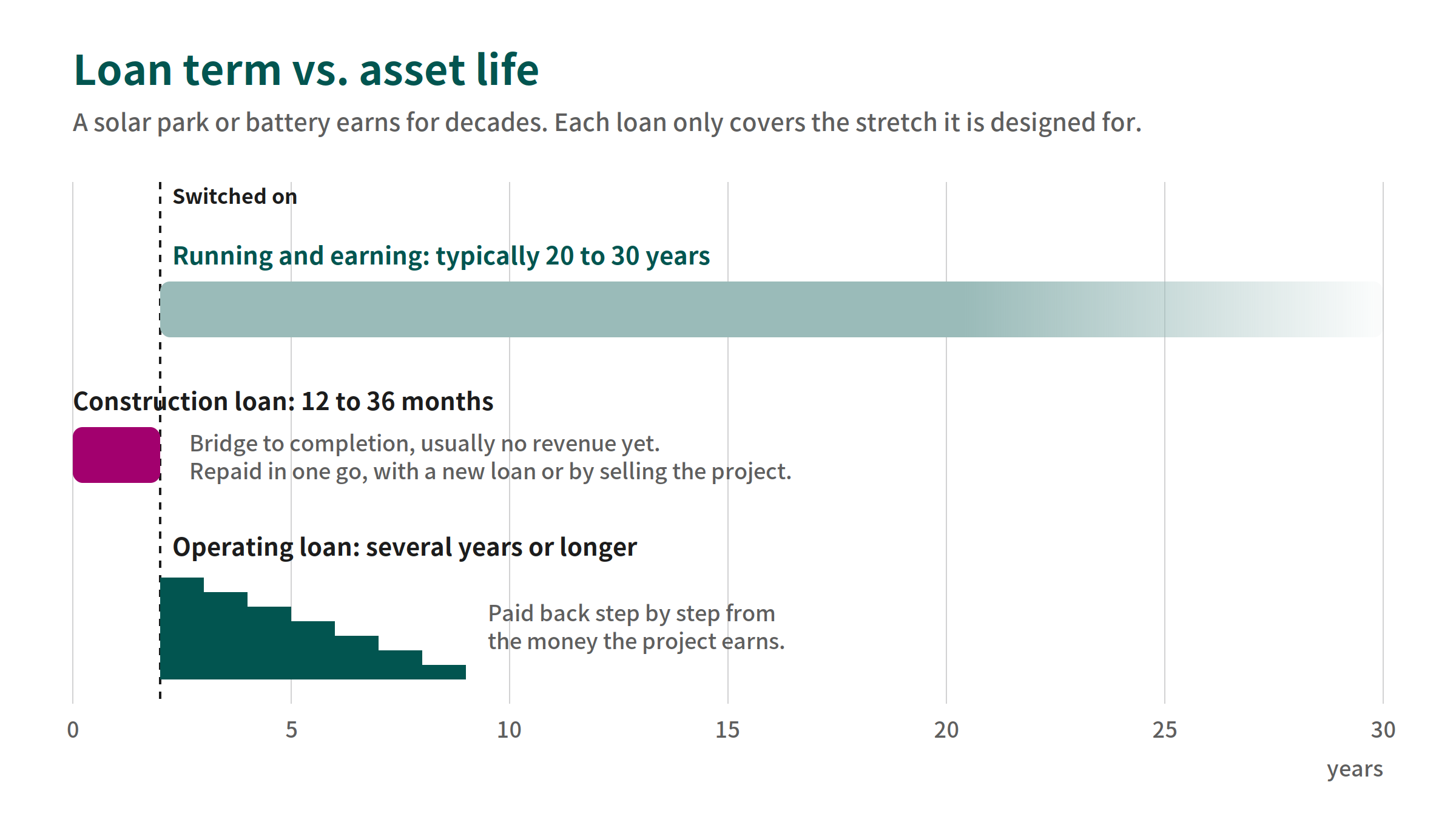
Solar parks and battery storage systems are built once and then earn income for many years. Lenders don’t size a loan around the asset’s technical lifetime alone. They look at when money comes in, how much comes in, and how reliably it arrives.
In other words, the loan runs as long as the project needs to repay it from what it earns, not as long as the solar panels last.
Two kinds of loans, two different jobs
A construction loan is a bridge. It finances the project until it’s finished. During this phase the project usually earns nothing yet. There is still a risk that building takes longer or costs more, or that permits or the grid connection are delayed. These loans typically run for 12 to 36 months. They are usually repaid in one go, either with a new long-term loan or by selling the finished project.
An operating loan works more like a mortgage paid from rent. The project is running and earns money regularly, for example by selling electricity. That money pays the running costs, the interest, and the agreed repayments. The loan is paid back bit by bit from what the project earns, rather than in one go.
In short: a construction loan pays for the building. An operating loan is paid back, bit by bit, from what the finished project earns.
Why the amount and the term belong together
Here is a simplified example. After paying its running costs, a project has €300,000 a year left over to pay its lenders. It borrows €1 million at an example interest rate of 6%. In the first year, that looks like this:
| 5-year loan | 7-year loan | |
|---|---|---|
| Repayment | €200,000 | about €143,000 |
| Interest | €60,000 | €60,000 |
| Money left as a safety cushion | €40,000 | about €97,000 |
With the longer term, the safety cushion for a weaker year is more than twice as big. So the longer term is not necessarily a sign of weakness. It may be the structure that makes the repayment plan realistic by aligning annual debt service with the project’s expected cash flow. It also means that investors remain exposed to the project for longer and may receive more interest in total over the life of the financing.
Put simply: the longer the term, the smaller each yearly repayment, and the easier it is for the project to keep up.
Seven years doesn’t mean seven years of waiting
Two features make a long term feel very different in practice: regular interest, often paid every quarter from early in the term, and repayment in steps, since many project loans pay back your invested money in instalments rather than as one lump sum at the end.
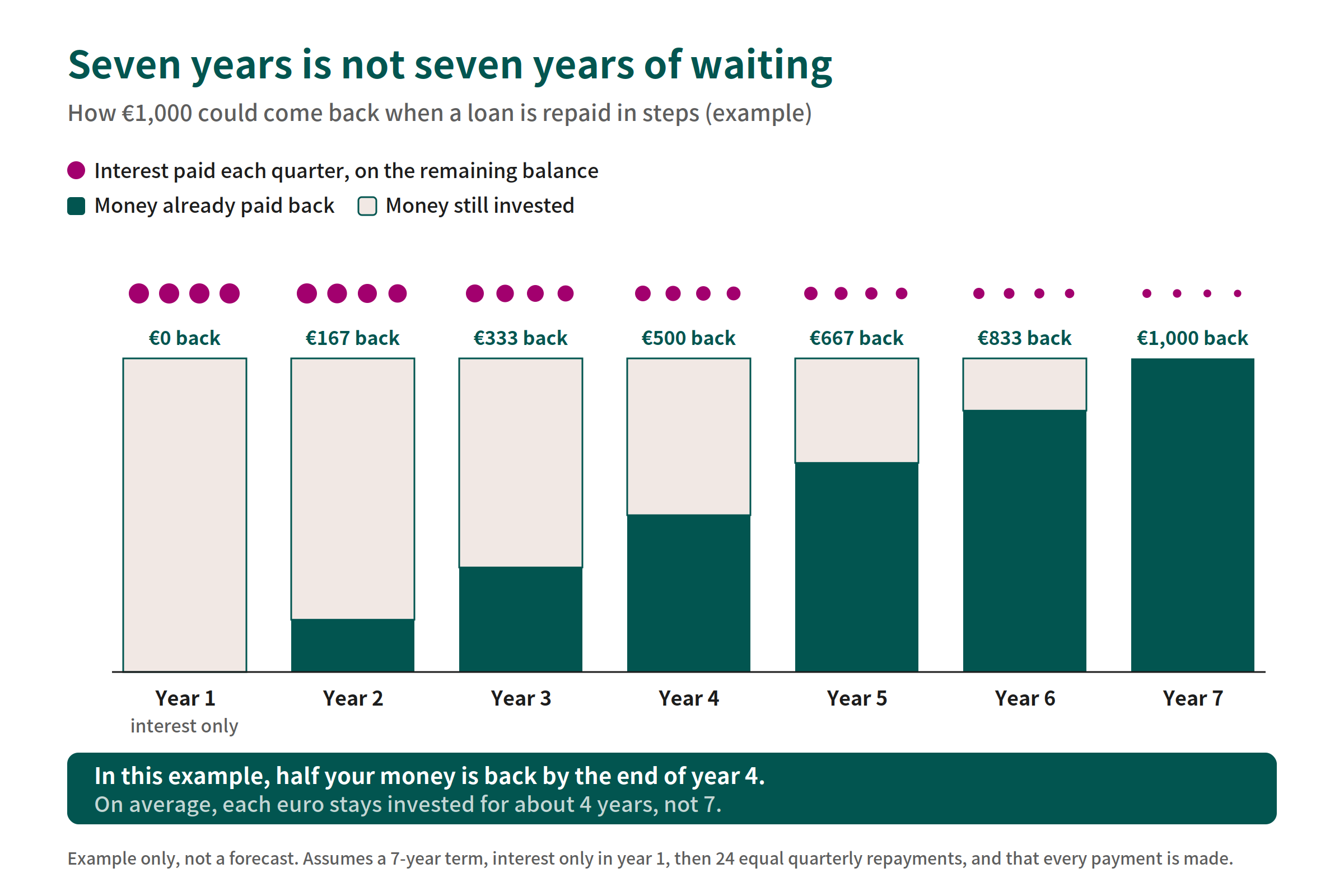
Imagine you invest €1,000 in a loan that runs for seven years. In the first year, you only receive interest. After that, part of your money comes back every quarter, in equal amounts. In this example, half the money is back by the end of year four. On average, each euro stays invested for about four years, not seven. Because interest is calculated on the amount still invested, the interest payments shrink as your money comes back.
This only holds if the project can make every payment as planned. Every offering has its own repayment schedule, set out in its Key Investment Information Sheet (KIIS).
Longer isn’t automatically safer, or riskier
A shorter term isn’t automatically safer, and a longer one isn’t automatically riskier. What changes is the kind of risk.
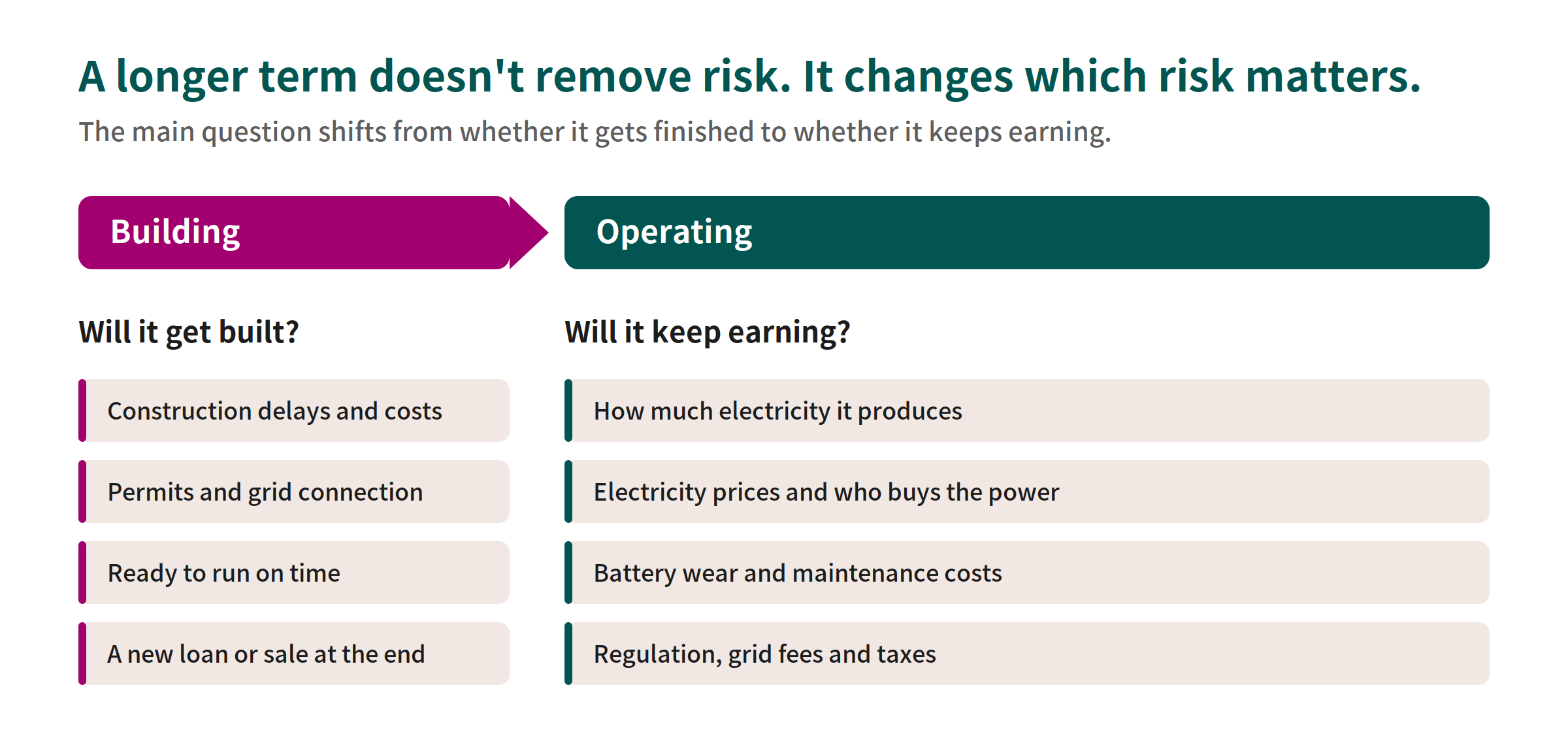
With a construction loan, the key question is whether the project will be finished and then paid off as planned. With a longer operating loan, the questions change. Will the solar park or battery keep working well? Will prices stay favourable? Will the technology perform as expected over the years?
Five questions to ask about any long-term project loan
- Where does the repayment money come from: what the project earns while running, or a future sale or new loan?
- Is the asset already producing, and what still has to be built?
- How stable is the income: fixed by contract, agreed with local customers, or dependent on market prices?
- When do you start getting your invested money back, and how is it spread over the term?
- Who is repaid first, the bank or investors, and is there any security (collateral)?
An example: an operating solar park meets new storage
The AEP Obernberg project in Upper Austria shows how these principles come together. It’s an operating asset: its solar park (about 6 MWp, a measure of its peak output) is already built, connected to the grid, and earning money from selling electricity. It’s also a new investment: a 6 MW / 12 MWh battery storage system is planned to start operating in the second quarter of 2027. MW describes how much power the battery can deliver at once, MWh how much energy it can store. The battery will only earn money once it has been built, connected, and switched on. The financing therefore combines an operating asset with a new investment.
The Invesdor financing runs for seven years. Interest is paid every quarter. Repayment of the invested money is planned to start in 2028, with the last payment scheduled for October 2033. So it works like a longer-term project loan, not like a short construction loan that is repaid as soon as building is finished.
The project also has a bank loan. This senior financing has priority in repayment over the subordinated financing offered through Invesdor, a repayment ranking that’s important when assessing the risk. View the AEP Obernberg funding round. To learn more about how large-scale battery storage earns money, read our article on battery storage as a key technology of the energy transition.
The bottom line
A long term isn’t a flaw to put up with. It’s a design choice, and it should match how and when the project earns its money. The right question isn’t “is seven years too long?” but “does this term fit this project’s cash flows?”
Frequently asked questions
Can I get my money back before the term ends?
Usually not. Crowdfunding bonds generally can’t be ended early, and there is usually no easy way to sell them to someone else. Selling your bond may be impossible, or only possible at a loss. Only invest money you are sure you won’t need during the full term.
When do I receive my first payment?
That depends on the offering. Many project loans pay interest quarterly from the first quarter onwards, while principal repayments often start later. The exact dates are set out in the KIIS and the bond terms.
Is my money repaid at the end or along the way?
It depends on the structure. With a “bullet” loan, the full amount is repaid in one go at the end. With a loan that is repaid in steps, your money comes back in instalments over the term, so on average it is invested for less time. Check the repayment schedule before you invest.
Why doesn’t the project just borrow for a shorter time?
A shorter term means larger repayments each year. If the project’s annual cash flow can’t comfortably cover those payments, a shorter term would increase the risk of a shortfall rather than reduce it. The term is chosen to match what the project can realistically repay.
Does a longer term mean a higher interest rate?
Not automatically. The interest rate reflects the overall risk of the investment: the project’s stage, how stable its revenues are, where the loan ranks behind bank debt, and the fact that your capital is tied up and hard to sell.
What happens if the project earns less than planned in a given year?
Interest or repayments may be delayed or reduced. Banks that lent to the project are usually paid first, and any security (collateral) may not cover everything investors are owed. In the worst case, a total loss is possible. It’s worth checking whether the project holds cash reserves or has a guarantee, and what they cover.
What do “senior” and “subordinated” mean?
They describe the order of repayment. Senior debt, usually from a bank, is repaid first. Subordinated debt is repaid only after the bank has been paid what it is owed. Subordinated lenders carry more risk and are typically compensated with a higher interest rate.
How does inflation affect a long-term loan?
With a fixed interest rate, money repaid in later years is worth less in real terms if inflation rises. Amortisation reduces this effect somewhat, because part of your capital comes back earlier.
What happens to my investment if the platform stops operating?
Your investment is a contract with the company that issued the bond, not with the platform. If the platform stops operating, your claims against that company remain. Payments or updates may be delayed while this is sorted out.
How much should I invest?
That is a personal decision, and this article is not advice. A common approach is to spread your money across several investments rather than putting it all into one, and to invest only money you could afford to lose.
Notes and risks
This article is for general information and is not investment advice. The examples are simplified. Crowd investments carry risks up to the loss of the invested money. Please read the Key Investment Information Sheet (KIIS) before investing.


Join many others, create your account!


100+
Related articles
How Direct Digital Investing can pave the way to the Stock Market
BIOGENA • Investment story • Direct digital investment BIOGENA investment story A family business becomes a health group. What began for BIOGENA as a family-run micronutrient company is today a health group with more than…

Real Estate Investment: Is Now the Right Time to Get Started?
The real estate market has changed: financing has become more complex, capital more selective, and project execution more demanding. At the same time, demand for new housing remains high — many projects today fail not…