
Pre-IPO Investing | How it works, Risks and Portfolio Role

Accessing growth before the public markets
Pre‑IPO investing means getting economic exposure to companies shortly before a potential IPO or exit, usually via structured instruments rather than direct shares. These investments can offer access to late‑stage growth but are illiquid, complex and high‑risk, and investors must be prepared for long holding periods and the possibility of a total loss.
Table of contents
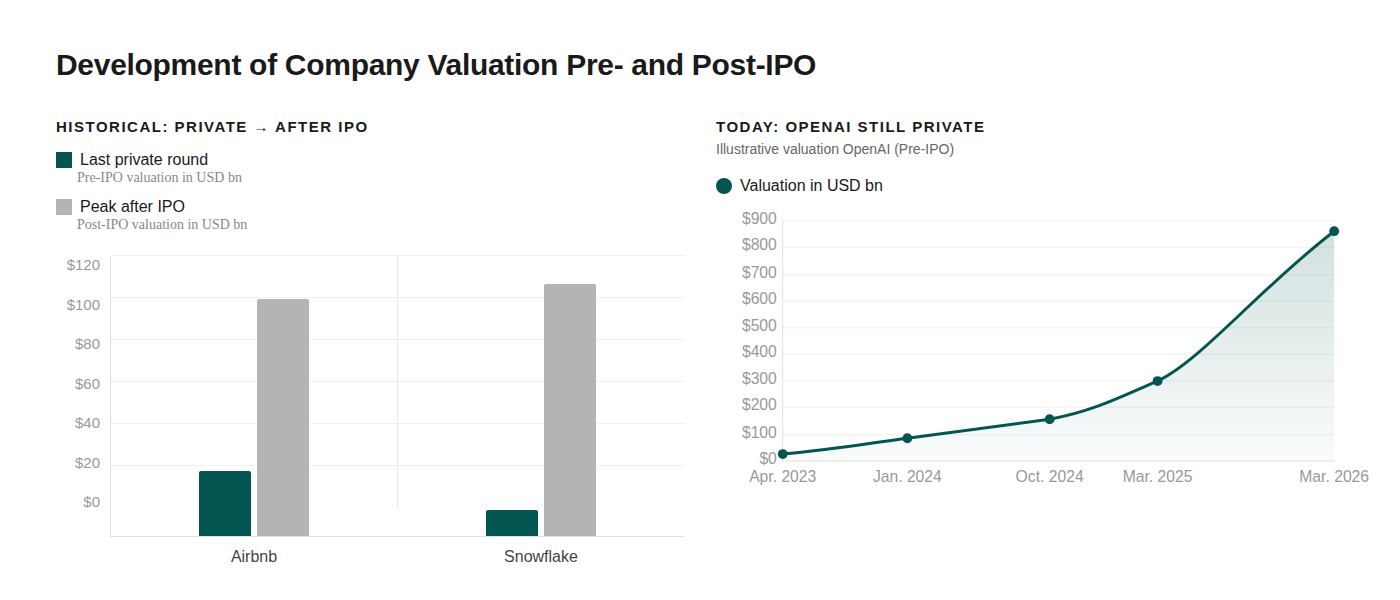
In recent years, some of the most significant value creations in global markets have happened before companies even reached the public stock exchange. Investors who gained early access to companies like Airbnb, Uber, or Snowflake often saw substantial valuation increases between late-stage private rounds and their eventual IPOs.
For example, Airbnb was valued at around $31 billion in private markets in 2017 and reached a market capitalisation of over $100 billion shortly after its IPO. Similarly, Snowflake became one of the largest software IPOs ever, delivering strong valuation uplifts from its final private funding rounds.
More recently, companies like OpenAI, Anthropic, and Oura have shown how quickly valuations in late-stage private markets can evolve – driven by technological breakthroughs, rapid adoption, and global market positioning.
At the same time, access to these opportunities has traditionally been limited to institutional investors, venture capital funds, and ultra-high-net-worth individuals.
Why is Invesdor offering Pre-IPO investments?
At Invesdor, we believe investors should be able to build diversified portfolios across the full company lifecycle. Invesdor already provides access to growth-stage startups and scale-ups through equity funding, as well as to more mature SMEs, renewable energy and real-estate investment opportunities via fixed-interest debt. Between these, there has traditionally been a gap.
Pre-IPO investments are designed to close this gap by offering investors access to late-stage companies that are already well-developed and often have a clear path toward an IPO or strategic exit within a few years.
The goal is to enable investors to participate in value creation from early growth all the way to the pre-IPO stage, while being transparent that these investments remain illiquid, high-risk, and should be considered as part of a diversified portfolio.
We are an impact-first investment platform. At the same time, we believe in expanding access to a broader range of opportunities, including pre-IPO investments. While the companies we currently have visibility on are not primarily impact- or ESG-focused, we will continue to monitor this space and aim to include more impact-aligned opportunities over time.
What is Pre-IPO investing? An introduction
Investing in companies before they go public has traditionally been reserved for institutional investors, venture capital funds, and ultra-high-net-worth individuals. However, access to these opportunities has gradually broadened, allowing a wider range of investors to participate in what is known as Pre-IPO investing.
In this article, we explain what Pre-IPO investing is, how it works in practice, and what investors should carefully consider before deciding to invest.
What does “Pre-IPO” mean?
A Pre-IPO investment refers to investing in a company while it is still privately held – meaning before its shares are listed and traded on a public stock exchange.
At this stage, companies are typically relatively mature. They often generate substantial revenue, have established business models, and are backed by experienced investors. In many cases, such companies are preparing for a potential exit such as an IPO or a strategic sale.
Typical characteristics of Pre-IPO companies include:
- A proven product or service with growing market traction
- Strong revenue growth and scaling operations
- Institutional investors already on the cap table
- A potential path toward an IPO or acquisition
These companies are often active in sectors driven by long-term trends such as technology, energy transition, or digital infrastructure, making them particularly relevant for forward-looking investors.
Why do investors consider Pre-IPO companies?
Investing in Pre-IPO companies can offer access to companies at a stage where significant growth potential still exists, while the business is already more developed than in early-stage venture investing.
Investors are typically attracted by a combination of strategic and financial considerations:
- Early access to growth – Invest in the potential return of a company before it enters public markets
- Potential valuation upside – Opportunity to benefit from future price increase at IPO or exit
- Diversification – Exposure to private markets alongside listed assets
- Innovation exposure – Access to some of the most innovative companies globally
At the same time, it is important to recognise that Pre-IPO investment opportunities are not directly comparable to listed equities. The expected investment horizon is longer and the risk associated with the investment product is higher.
How does Pre-IPO investing work in practice?
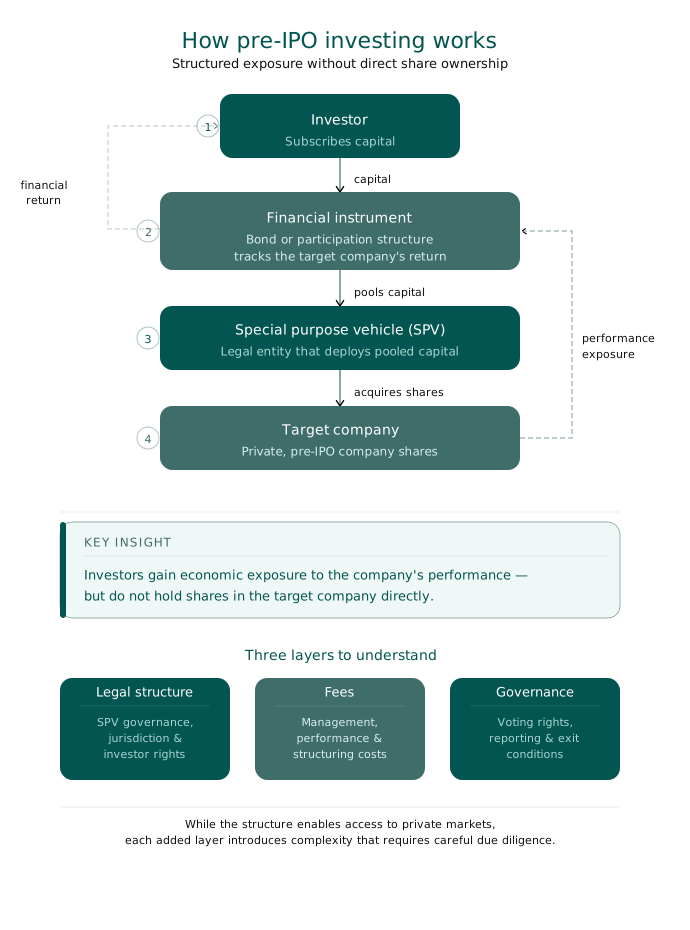
Unlike investing in publicly listed shares, Pre-IPO investments are usually structured indirectly through so-called derivatives, as direct access to company shares is often restricted.
In practice, the structure often works as follows:
- Investors subscribe to a financial instrument (e.g. a bond or participation structure)
- The financial instrument is constructed to follow the return of the target company
- The invested capital is pooled and deployed via special purpose vehicles (SPVs)
- These SPVs acquire shares in the target company
- Investors get financial exposure towards the performance of the target company
This means that investors do not hold shares in the target company directly but gain exposure to the return of the target company through a structured setup. While this structure enables access, it also comes with additional layers that need to be understood, including legal structure, fees, and governance.
Typical exit scenarios for Pre-IPO investments
Pre-IPO investments are by default long-term investments, where the return depends on a successful future exit event. The exit may be significantly delayed, occur later than anticipated, or not happen at all.
The most common exit routes include:
- Initial Public Offering (IPO) – The target company lists its shares on a stock exchange
- Mergers and Acquisitions (M&A) – The target company is acquired by another firm
- Secondary transactions – The shares of the target company are sold to other private investors
It is important to highlight that the timing and likelihood of an exit is uncertain. Even if a company has communicated IPO ambitions, market conditions or strategic decisions can delay or prevent such an outcome. In addition, lock-up periods after an IPO may restrict immediate liquidity.
Typical Pre-IPO investment timeline
1
Investment – You subscribe to the financial instrument and capital is deployed into the SPV
2
Hold period (2–5 years) – Capital is illiquid. The company continues scaling toward a potential exit
3
Exit event – IPO, acquisition, or secondary sale triggers a liquidity event
4
Return – Proceeds are distributed to investors via the SPV structure (lock-up periods may apply after IPO)
Pre-IPO investments: understanding the key risks
Investing in Pre-IPO companies is associated with a higher level of risk compared to traditional listed equities, and a clear understanding of these risks is essential.
Key risk factors include:
- Total loss risk – The invested capital can be lost entirely
- Illiquidity – Capital is typically tied up for several years
- Structural complexity – Indirect investment structures add additional layers
- Valuation uncertainty – Private market pricing can change significantly
- External influences – Market conditions, regulation, and macroeconomic factors impact outcomes
In addition, investors should consider that fees, dilution effects, and currency fluctuations may further influence the final return and potentially reduce performance.
Important
Pre-IPO investments are high-risk and illiquid. Capital can be tied up for several years and may be lost entirely. These investments should only be considered as part of a well-diversified portfolio. Higher potential returns are always accompanied by higher risks.
Pre-IPO investments in a portfolio: how to position them effectively
Investments in Pre-IPO companies can play a valuable role within a diversified portfolio, particularly for investors seeking exposure to innovation and long-term growth trends.
However, Pre-IPO companies should be positioned carefully. In most cases, such investments are best understood as:
- A complementary allocation to traditional investments such as listed equities or bonds
- A long-term investment with limited liquidity
- An opportunity-driven exposure where the expected risk and return is higher than in traditional investment products
Diversification across assets and a clear understanding of the individual target companies is essential.
New investment opportunities: access for retail investors
By offering investors access to invest in Pre-IPO companies, Invesdor gives retail investors access to a part of the market that has historically been available only to professional investors. This allows investors to participate in the potential return of some of the most innovative companies globally before they enter public markets and become available to the public.
At the same time, this access comes with increased complexity and risk. Understanding the structure, evaluating the underlying company, and taking a long-term view on the investment are all critical elements of a sound investment decision.
As with any investment, one principle remains unchanged:
Higher potential returns are always accompanied by higher risks, and building a diversified portfolio is key for sustainable success.
Disclaimer: This article is for informational purposes only and does not constitute investment advice, an offer or a recommendation to invest in any specific Pre-IPO product. Pre-IPO investments are complex and high-risk. Investors should read all product documentation carefully and consider seeking independent advice.
Get early access
Join the waiting list and be the first to hear about new Pre-IPO investment opportunities on Invesdor – before they open to the public.
Join the waiting list and get early access

Join many others, create your account!


100+
Related articles

How Direct Digital Investing can pave the way to the Stock Market
BIOGENA • Investment story • Direct digital investment BIOGENA investment story A family business becomes a health group. What began for BIOGENA as a family-run micronutrient company is today a health group with more than…

Real Estate Investment: Is Now the Right Time to Get Started?
The real estate market has changed: financing has become more complex, capital more selective, and project execution more demanding. At the same time, demand for new housing remains high — many projects today fail not…